← All passes
Mountain pass No. 49 No live data

Texas Canyon Pass

Texas Canyon is the high point of Interstate 10 in Arizona. The summit, just past the Texas Canyon Rest Area near milepost 320, sits at 4,974 feet, and the westbound lanes briefly cross above 5,000 feet (AARoads; Wikipedia, "Interstate 10 in Arizona"). The road climbs from the Sa

4,975Elevation (ft)
1,516Metres
I-10Route
AZState
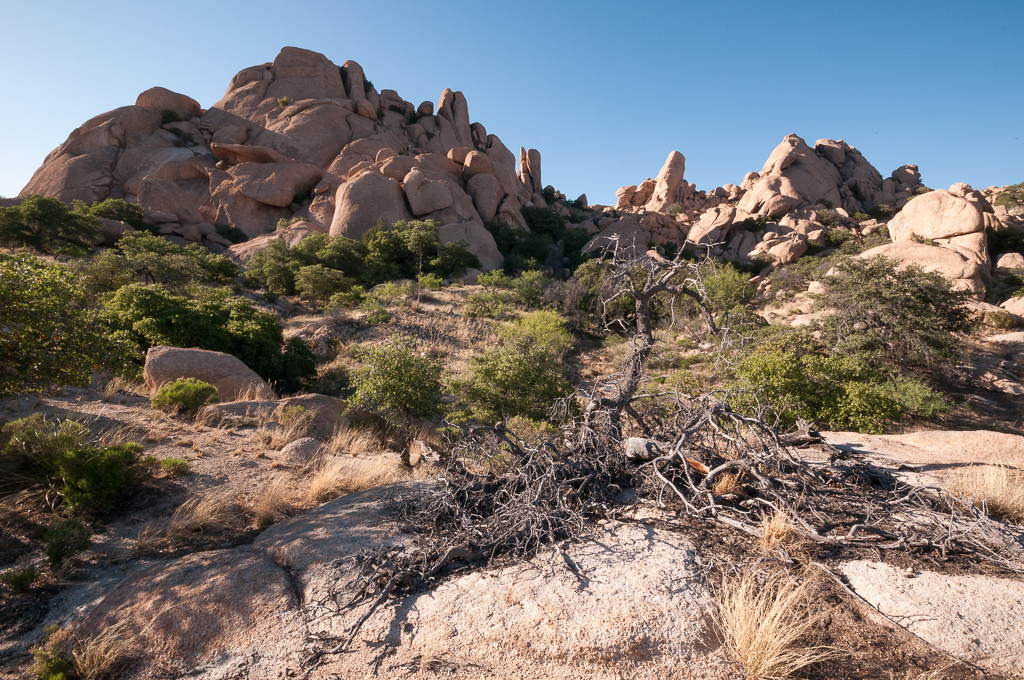
The distinctive granite boulders of Texas Canyon in Cochise County, Arizona, the rugged terrain I-10 climbs through near the 4,975-foot pass.
The distinctive granite boulders of Texas Canyon in Cochise County, Arizona, the rugged terrain I-10 climbs through near the 4,975-foot pass.Heidi Donat (StellarD) / Wikimedia Commons · CC BY-SA
00 Live conditions
No live data
No live condition feed for this pass right now. Check the state DOT or 511 before you climb.
01 Overview

Texas Canyon is the high point of Interstate 10 in Arizona. The summit, just past the Texas Canyon Rest Area near milepost 320, sits at 4,974 feet, and the westbound lanes briefly cross above 5,000 feet (AARoads; Wikipedia, "Interstate 10 in Arizona"). The road climbs from the San Pedro Valley and Benson up into rocky Texas Canyon, threading between the Little Dragoon Mountains to the north and the Dragoon Mountains to the south, in Cochise County in the southeastern corner of the state.

If you are picturing a snow pass with chain-up areas, set that aside. This is a long, gradual ascent, not a steep mountain grade. Benson sits at about 3,585 feet, so the net rise to the summit is roughly 1,400 feet over about 20 miles east (Benson elevation: elevation.maplogs/DesertUSA; summit: AARoads). No state DOT publishes a grade percentage for it, so do not expect one. Arizona has no chain-control system, and there is no designated chain-up or brake-check area here.

The hazard that actually strands truckers on this part of I-10 is blowing dust, and it hits east of the summit. Between Willcox and the New Mexico line, around San Simon and Bowie, strong winds kick up dust that can drop visibility to nothing. ADOT has closed 60-plus miles of I-10 in both directions during dust events, with detours running 100-plus miles via Safford and Duncan (tucson.com; weather.com). Texas Canyon itself is also a DPS-named serious-crash hot spot, where the road curves past jumbles of boulders at the north end of the Dragoon Mountains.

  • Texas Summit is the highest point of I-10 in Arizona at 4,974 feet, just past the Texas Canyon Rest Area near milepost 320; westbound lanes briefly top 5,000 feet (AARoads; Wikipedia, Interstate 10 in Arizona)
  • The climb is a long, gradual rise of about 1,400 feet from Benson (~3,585 ft) over roughly 20 miles, not a steep mountain grade (Benson elevation: elevation.maplogs/DesertUSA)
  • No state-DOT grade percentage was found for Texas Canyon; Mountain Directory has no entry for it, so no specific grade is published here
  • Arizona has no chain-control system and no chain-up law; there is no designated chain-up or brake-check area at Texas Canyon (AZ MVD rules summary)
  • The Texas Canyon Rest Area (about MP 320, both directions, ~70 mi east of Tucson) has truck parking covered by ADOT's Truck Parking Availability System, with live counts on AZ511 (ADOT TPAS project page)
  • A June 19, 2017 dust storm near Lordsburg, NM caused a 25-vehicle pileup that killed 6 (abc15.com)
  • An April 26, 2016 dust event near San Simon closed 62 miles of I-10, with gusts reported near 45 mph (weather.com)
02 Chain controls & closures

There is no chain-control season at Texas Canyon, because Arizona runs no chain-control system. There are no R-1/R-2/R-3 levels and no chain-up law like California, Colorado, or Oregon. Under Arizona rules, chains of reasonable proportions are allowed when you need traction, and chains or snow tires are only required if ADOT posts a sign for immediate conditions, which happens mainly on northern-Arizona mountain routes (AZ MVD rules summary). The summit itself rarely closes for weather. At about 4,974 feet, a strong winter storm can bring snow and ice on occasion, but no documented pattern of regular winter closures at Texas Canyon was found. The closures that actually shut this stretch of I-10 are dust-storm closures a few miles east, between Willcox and the New Mexico line, and those can come with little warning during high-wind events (AARoads; tucson.com; weather.com). When it happens, ADOT manages it with posted advisories, speed reductions, and closures, not chains. Check AZ511 or call 511 before you run it.

03 Notable hazards
Hazard

Blowing dust east of the summit

The real headline hazard sits past the top, between Willcox and the New Mexico line through the San Simon Valley and Bowie. High winds whip up dust that can drop visibility fast, and ADOT has closed 60-plus miles of I-10 in both directions during these events, with detours of 100-plus miles via Safford and Duncan. Gusts near 45 mph have been reported. Sources: AARoads (I-10 East, Willcox to New Mexico); tucson.com; weather.com.

Hazard

Deadly dust-storm pileups nearby

This corridor has a record of mass-casualty crashes in blowing dust. On June 19, 2017, a sudden dust storm on I-10 near Lordsburg, NM, just east of the Arizona line, caused a 25-vehicle pileup (18 trucks, 7 cars) that killed 6. On April 26, 2016, dust off a plowed field near San Simon closed a 62-mile stretch of I-10. Sources: abc15.com; weather.com; tucson.com.

Hazard

Texas Canyon crash hot spot

Arizona DPS names this area as a site of serious I-10 crashes, either between mileposts 301 and 302 west of Benson or in Texas Canyon itself, where the road passes jumbles of boulders at the north end of the Dragoon Mountains. The curves and the rock-walled, scenic terrain are part of why it is dangerous. Source: tucson.com, 'I-10's lethal hot spots lie in wait for unwary.'

Hazard

Crosswind and rollover risk on the open plain

From Benson east across the Willcox plain the country is open and windy. Commercial-vehicle rollovers recur on I-10 in Cochise County, including a westbound rollover near Willcox around milepost 336. Crosswind is a real factor for empty or high-profile trailers across this stretch. Sources: KGUN9 and KOLD Cochise County rollover reporting.

Hazard

Occasional winter cold and snow at elevation

At about 4,974 feet, a strong winter storm can drop snow toward 4,000 feet in southern Arizona and bring ice risk. NWS Tucson is the forecast office and issues winter weather advisories for the Benson and Willcox corridor when that happens. This is occasional, not a defining seasonal hazard. Sources: NWS Tucson; tucsonsentinel.com freeze and snow reporting.

04 History

Texas Canyon has been a travel corridor since long before the interstate. The Butterfield Overland Mail stagecoach route ran through the canyon from 1858 until the Civil War interrupted it in 1862 (Wikipedia, "Texas Canyon"). The Dragoon Mountains alongside the canyon held the Apache leader Cochise's final stronghold. In the 1880s, pioneer David A. Adams, who came from Coleman County, Texas, settled the area, and the Texas name reflects those Texas connections and the road heading toward Texas (Wikipedia, "Texas Canyon"; AARoads notes it was "named for being on the road to Texas"). In the 1930s, William Shirley Fulton established the Amerind Foundation, an archaeological and ethnographic research center, library, and museum, near what is now I-10 exit 318.

I-10 came through this corridor in the mid-20th century. The first Arizona I-10 construction funded under the 1956 Federal Aid Highway Act ran from 1957 to 1960, and the Benson bypass opened around 1979, one of the last Arizona sections completed aside from the Phoenix gap (AARoads / interstate-guide construction history). The Texas Canyon Rest Area at milepost 320, about 70 miles east of Tucson, closed for roughly six months and about $3 million in work, then reopened June 30, 2016 (ADOT). ADOT later added a Truck Parking Availability System at the site so drivers can see open spaces.

05 FAQ
Is Texas Canyon the highest point on I-10 in Arizona?
Yes. Texas Summit, just past the Texas Canyon Rest Area near milepost 320, is the high point of I-10 in Arizona at 4,974 feet, and the westbound lanes briefly cross above 5,000 feet (AARoads; Wikipedia, Interstate 10 in Arizona).
Do I need tire chains for Texas Canyon?
No. Arizona has no chain-control system and no chain-up law here. Chains are only required if ADOT posts a sign for immediate conditions, which mostly happens on northern routes, and there is no designated chain-up or brake-check area at Texas Canyon.
How steep is the Texas Canyon grade for trucks?
It is a long, gradual climb, not a steep mountain grade. The road rises about 1,400 feet from Benson, near 3,585 feet, over roughly 20 miles to the 4,974-foot summit. No state DOT publishes a grade percentage for it, so do not trust any specific figure you see (Benson elevation: elevation.maplogs/DesertUSA; summit: AARoads).
Does I-10 close at Texas Canyon in winter?
The summit itself rarely closes for weather. The closures that actually hit this part of I-10 are dust-storm closures a few miles east, between Willcox and the New Mexico line, which can shut 60-plus miles with detours of 100-plus miles. Check AZ511 or call 511 before you go (AARoads; tucson.com; weather.com).
Why is Texas Canyon considered dangerous?
Arizona DPS lists it as a serious-crash hot spot, with curving road through boulder fields at the north end of the Dragoon Mountains. The broader corridor is also prone to blowing dust and to high-profile-truck rollovers in crosswinds (tucson.com, 'lethal hot spots').
Is there truck parking at Texas Canyon?
Yes. The Texas Canyon Rest Area, about milepost 320 in both directions and roughly 70 miles east of Tucson, has separate truck parking and is covered by ADOT's Truck Parking Availability System. Live space counts are on AZ511. An exact space count was not found in a primary source, so use the AZ511 live count (ADOT TPAS project page).
06 Related routes

Texas Canyon Pass on the live map

See conditions, incidents, and weather around Texas Canyon Pass in real time.

Open Live Map