Snoqualmie Pass carries I-90 over the Cascades at 3,022 feet, near milepost 52 and about 50 miles east of downtown Seattle. From November 1 to April 1, any vehicle over 10,000 pounds GVWR must carry chains between North Bend (MP 32) and Ellensburg (MP 101), whatever the weather.
WSDOT counts an average of 34,000 vehicles a day over the pass, thousands of them trucks. I-90 is the only interstate across the Washington Cascades: I-5 stays west of the range and I-82 stays east of it. When Snoqualmie closes, the year-round alternatives are US 2 over Stevens Pass, which sits about 1,000 feet higher at 4,061 feet, and US 12 over White Pass. WSDOT shuts SR 410 over Chinook Pass and SR 20, the North Cascades Highway, for the winter. Both US 2 and US 12 are on the same November to April chain-carry list as I-90.
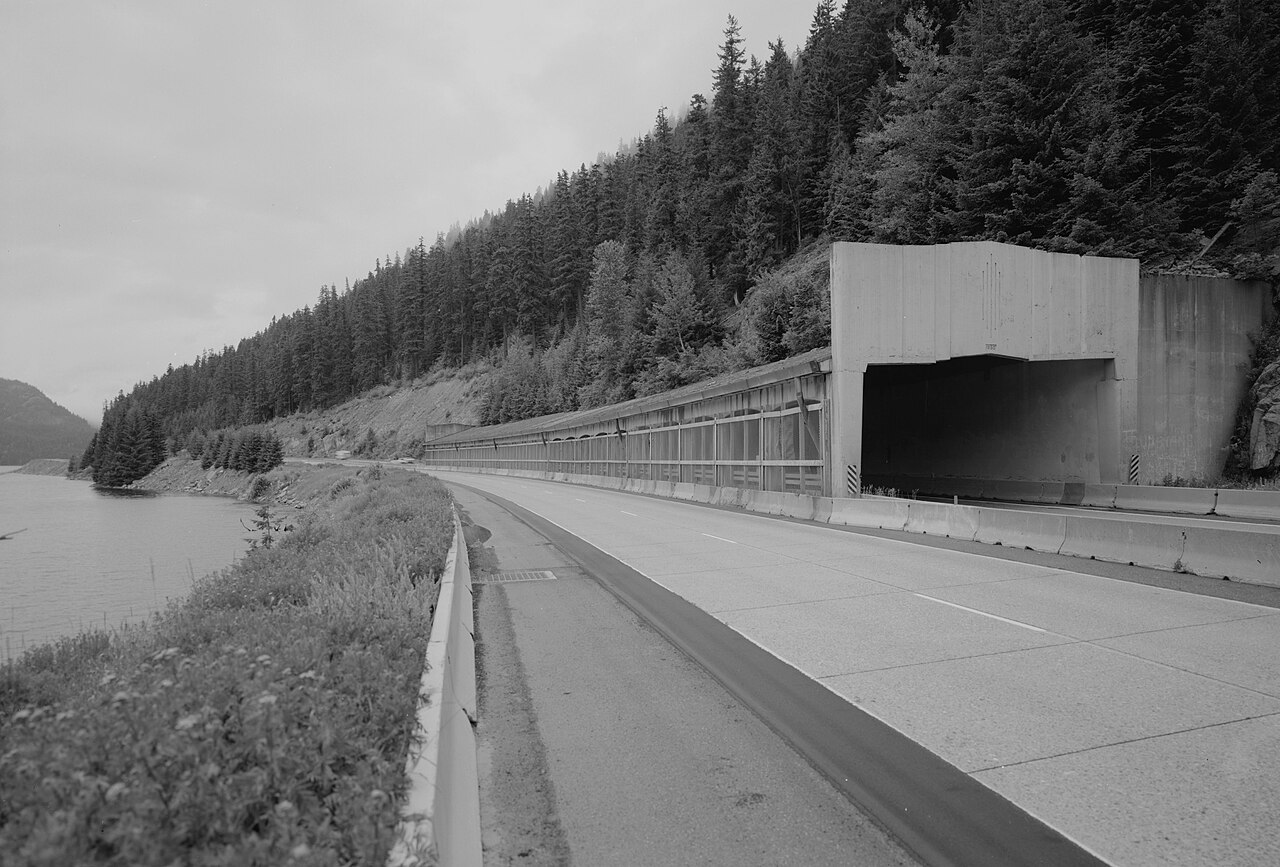
East of the summit, the road runs along Keechelus Lake between Hyak (MP 55) and Keechelus Dam (MP 60.5). Since 2009 WSDOT has been rebuilding the 15 miles from Hyak to Easton as a six-lane freeway under the I-90 Snoqualmie Pass East project. The finished phases, Hyak to the Stampede Pass interchange, put the highway on twin avalanche bridges near MP 58 and added a wildlife overcrossing at MP 61.3. Phase 3, Cabin Creek to West Easton, is under construction with completion scheduled for fall 2028. In 2026 eastbound traffic runs on the westbound side between MP 68 and 70, with two lanes open each way. Phases 3 and 4 add truck-climbing lanes and new chain-up areas. Phase 4, Stampede Pass to Cabin Creek, has not started.
- Summit elevation 3,022 ft (WSDOT), at I-90 milepost 52
- Vehicles over 10,000 lb GVWR must carry chains Nov 1 to Apr 1 from North Bend (MP 32) to Ellensburg (MP 101), plus at least two extra chains (WAC 204-24-050)
- Heavy vehicles have to mount chains once WSDOT posts "Traction tires required" (WSDOT)
- Ignoring a posted chain requirement is a $500 traffic infraction, assessments included (RCW 47.36.250)
- Avalanche control delays usually run 30 minutes to two hours, longer in severe storms (WSDOT)
- The weather station at the pass averaged about 420 inches of snow a year over its 1910 to 2002 record (Western Regional Climate Center)