← All passes
Mountain pass No. 11 Open

Loveland Pass

Loveland Pass carries US-6 over the Continental Divide in Colorado at 11,990 feet, the highest pass in the state that stays open through the winter. It sits about 800 feet above the Eisenhower-Johnson Memorial Tunnel that takes I-70 under the divide, and it is the road every plac

11,990Elevation (ft)
3,655Metres
US-6Route
COState
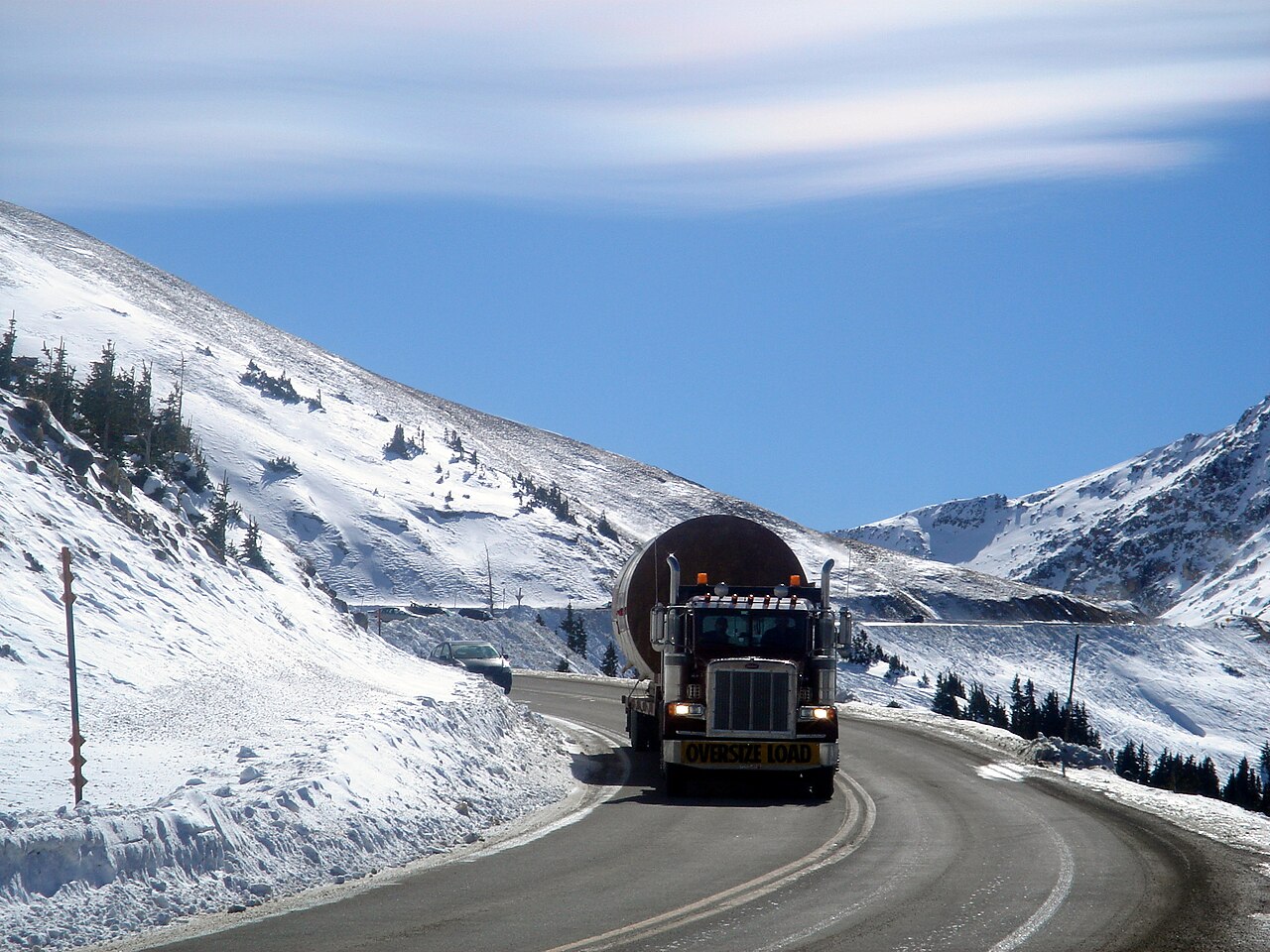
A semi on US-6 over Loveland Pass in winter
A semi on US-6 over Loveland Pass in winterDion Gillard / Wikimedia Commons · CC BY 2.0
00 Live conditions
Open
Temperature
40°F
Road
Clear
Weather
40°F, Clear
Northbound
No restrictions
Southbound
No restrictions

Reported Jun 2, 2026, 11:22 PM MT. Conditions change fast at elevation; confirm with the DOT before you commit.

01 Overview

Loveland Pass carries US-6 over the Continental Divide in Colorado at 11,990 feet, the highest pass in the state that stays open through the winter. It sits about 800 feet above the Eisenhower-Johnson Memorial Tunnel that takes I-70 under the divide, and it is the road every placarded hazmat truck has to take, because tankers and other placarded loads are banned from the tunnel year-round. Over-height rigs taller than the tunnel's 13 feet 11 inches detour over the top too. On an average day around 200 hazmat trucks climb the pass while roughly 30,000 vehicles run the tunnel below.

This is a two-lane mountain road with a steady 6.7 percent grade and a stack of tight hairpin switchbacks on both sides of the summit. There is little margin and not much guardrail. The Colorado State Patrol describes it as self-policing: trucks crawl up and drivers slow way down, which is part of the point of sending placarded loads over an open road instead of through a confined tunnel. The reason behind the ban is fire. CDOT's analysis found a gasoline fire could put out about 100 megawatts of heat, while the tunnel is built for 20.

  • Summit 11,990 ft on US-6, the highest Colorado pass kept open all winter
  • The mandatory year-round route for placarded hazmat trucks banned from the Eisenhower-Johnson Tunnel on I-70
  • Steady 6.7 percent grade with hairpin switchbacks on both sides; about 800 ft higher than the tunnel
  • Roughly 200 hazmat trucks a day take the pass; the tunnel below handles about 30,000 vehicles (Summit Daily)
  • Commercial vehicles must carry chains on I-70 from Dotsero (MP 133) to Morrison (MP 259), Sep 1 to May 31 (CDOT)
02 Chain controls & closures

Colorado's commercial chain law covers the I-70 corridor that feeds the pass. Every commercial vehicle on I-70 between Dotsero at milepost 133 and Morrison at milepost 259 has to carry chains from September 1 through May 31, and getting caught without them runs about $100 plus a surcharge. When CDOT and the State Patrol activate the Code 18 chain law in a storm, anything rated 26,001 pounds or more has to put chains on at least four drive tires before going on. The formal chain stations sit on the I-70 approach, at Herman Gulch, Bakerville, and Georgetown, with the Dillon chain station and brake-check on the west side. US-6 over the summit is a two-lane state highway without that network, so chain up before you start the climb. The pass closes case by case for avalanche control, whiteouts, wrecks, and slides, and because it is higher and more exposed than the tunnel, it usually closes first. When it does, CDOT escorts the hazmat loads through the tunnel in a convoy at the top of each hour and holds the rest of I-70 while they pass.

03 Notable hazards
Hazard

Hairpin switchbacks with little guardrail

The road climbs and drops at a steady 6.7 percent through tight switchbacks, two lanes and exposed, with not much barrier on the edge. It rewards a slow crawl and punishes anything else.

Hazard

Tanker fire risk

In August 2009 a tanker carrying 7,300 gallons of fuel rolled on a corner of westbound US-6, hit the rail, and was burning within seconds, with flames over 30 feet. The driver got out. This is the exact fire CDOT keeps out of the tunnel: its study put a gasoline fire near 100 megawatts against the tunnel's 20.

Hazard

Avalanche terrain

The pass crosses active avalanche paths and closes for control work. An April 2013 slide near the summit killed five snowboarders, Colorado's deadliest avalanche since 1962.

Hazard

Rock and debris slides

Saturated spring snowmelt can bury the road. A slide about 100 feet wide and 15 to 20 feet deep hit US-6 at milepost 226 in June 2025 and closed the pass for weeks with no set reopening date.

Hazard

Weather at almost 12,000 feet

The summit gets whiteouts, ice, and high wind. CDOT steps up from a passenger traction law to the commercial chain law to a full closure, and the pass is usually shut before the tunnel in a big storm.

04 History

The pass takes its name from William Loveland, president of the Colorado Central Railroad, and the first usable trail over it was finished in 1879. Crews paved the modern road in 1949 and 1950, decades before the tunnel opened beneath it.

When the Eisenhower-Johnson Memorial Tunnel carried I-70 under the divide, it cut 9.1 miles off the US-6 route, but it left hazmat carriers, over-height trucks, bicycles, and pedestrians up top, and they still climb the pass today. The mountains here are not forgiving. An avalanche near the pass on April 20, 2013 killed five backcountry snowboarders, the deadliest in Colorado since 1962.

05 FAQ
Do I have to take Loveland Pass if my truck is placarded?
Yes. Placarded hazmat loads are banned from the Eisenhower-Johnson Tunnel on I-70 and have to use US-6 over Loveland Pass whenever the pass is open. The ban comes from fire risk: CDOT found a gasoline fire could reach about 100 megawatts against the tunnel's 20-megawatt design.
What happens to my hazmat load when the pass is closed?
CDOT escorts placarded trucks through the tunnel in a convoy at the top of each hour and holds the rest of I-70 while you pass. A closed pass means a wait for the next escort, not a long reroute.
How tall can my truck be to use the tunnel instead?
The tunnel clearance is 13 feet 11 inches. Height detectors at each portal trip a red signal and a siren if you are over, and you have to turn around and take the pass.
How steep is it?
A steady 6.7 percent through hairpin switchbacks to an 11,990-foot summit on the Continental Divide. It is the highest Colorado pass that stays open all winter.
When do I carry or install chains?
Commercial vehicles carry chains on I-70 from Dotsero (MP 133) to Morrison (MP 259) from September 1 to May 31. When the chain law is active, rigs at 26,001 pounds and up put chains on at least four drive tires. Running without the required carry costs about $100 plus a surcharge.
How often does it close, and why?
There is no schedule. CDOT and the State Patrol close it case by case for avalanche control, whiteouts, wrecks, and slides, and it usually closes before the tunnel in a big storm. A June 2025 mountain slide at milepost 226 shut it for weeks.
06 Related routes

Loveland Pass on the live map

See conditions, incidents, and weather around Loveland Pass in real time.

Open Live Map