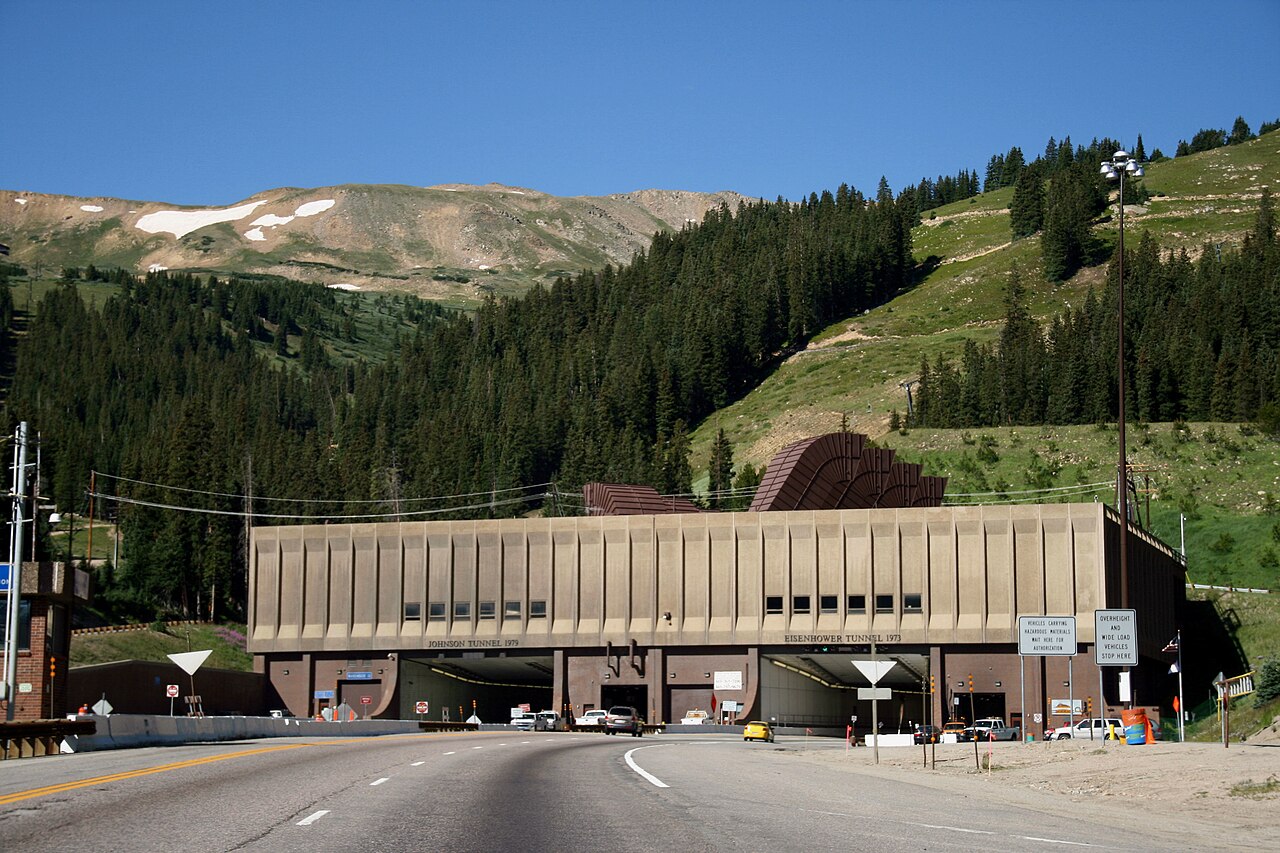
The Eisenhower-Johnson Memorial Tunnel takes I-70 under the Continental Divide about 60 miles west of Denver. Its west portal, at 11,158 ft, is the highest point on the Interstate system. Placarded hazmat may not use it while Loveland Pass is open, and clearance is 13 ft 11 in.
The tunnel is two separate bores. Westbound traffic uses the Eisenhower bore, 1.693 miles long, and eastbound traffic uses the Johnson bore, 1.697 miles long. Each bore has two 13-foot lanes and no shoulders or pull-outs. Inside, the road climbs 1.64 percent toward the west, so the east portal sits lower, at 11,013 ft. The grades outside are steeper: CDOT puts the west approach at 7 percent and the east approach at 6 percent (CDOT).
The ceiling over the lanes is 16 ft 4 in, but message boards hang from it, so the posted clearance in both bores is 13 ft 11 in (CDOT; 2 CCR 601-8). A taller load has to cross the divide on US 6 over Loveland Pass. Placarded hazardous materials go that way too whenever the pass is open, and a few hazmat classes are barred from the tunnel even when it is closed.
CDOT staffs the tunnel around the clock with more than 30 full-time employees, all trained as firefighters, and keeps its own fire truck and tow truck on site (CDOT). In 2025 the two bores carried 12.57 million vehicles, about 34,400 a day. July averaged just over 40,000 a day (CDOT traffic counts).
- West portal 11,158 ft, east portal 11,013 ft. CDOT gives the average as 11,112 ft, and FHWA lists the tunnel as the highest point on the Interstate Highway System (CDOT; FHWA).
- Eisenhower bore (westbound): 1.693 miles, opened March 8, 1973. Johnson bore (eastbound): 1.697 miles, opened December 21, 1979 (CDOT).
- Posted clearance is 13 ft 11 in in both bores (2 CCR 601-8; CDOT).
- Grade inside the tunnel is 1.64 percent rising to the west. The approaches are 7 percent on the west side and 6 percent on the east side (CDOT).
- Placarded hazmat must use US 6 over Loveland Pass whenever the pass is open (2 CCR 601-8, Rule 3.02).
- The tunnel is at I-70 milepost 213. Commercial vehicles may not use the far-left lane from milepost 205.5 to 221.0 except to pass (C.R.S. 42-4-1014).
- From September 1 through May 31, commercial vehicles with a declared GVWR of 16,001 lb or more must be equipped with chains or approved traction devices on I-70 west of Morrison, which includes the tunnel (C.R.S. 42-4-106(5)(a)(I)(C)).
- The tunnel saves 9.1 miles compared with US 6 over Loveland Pass (CDOT).