← All passes
Mountain pass No. 10 Open

Vail Pass

Vail Pass tops out at 10,662 feet (3,250 m) and carries I-70 across Colorado between Vail and the Copper Mountain/Frisco side, through Eagle and Summit counties (Wikipedia). The interstate over the pass went in between 1973 and 1978. It was one of the harder pieces of I-70 to bui

10,662Elevation (ft)
3,250Metres
I-70Route
COState
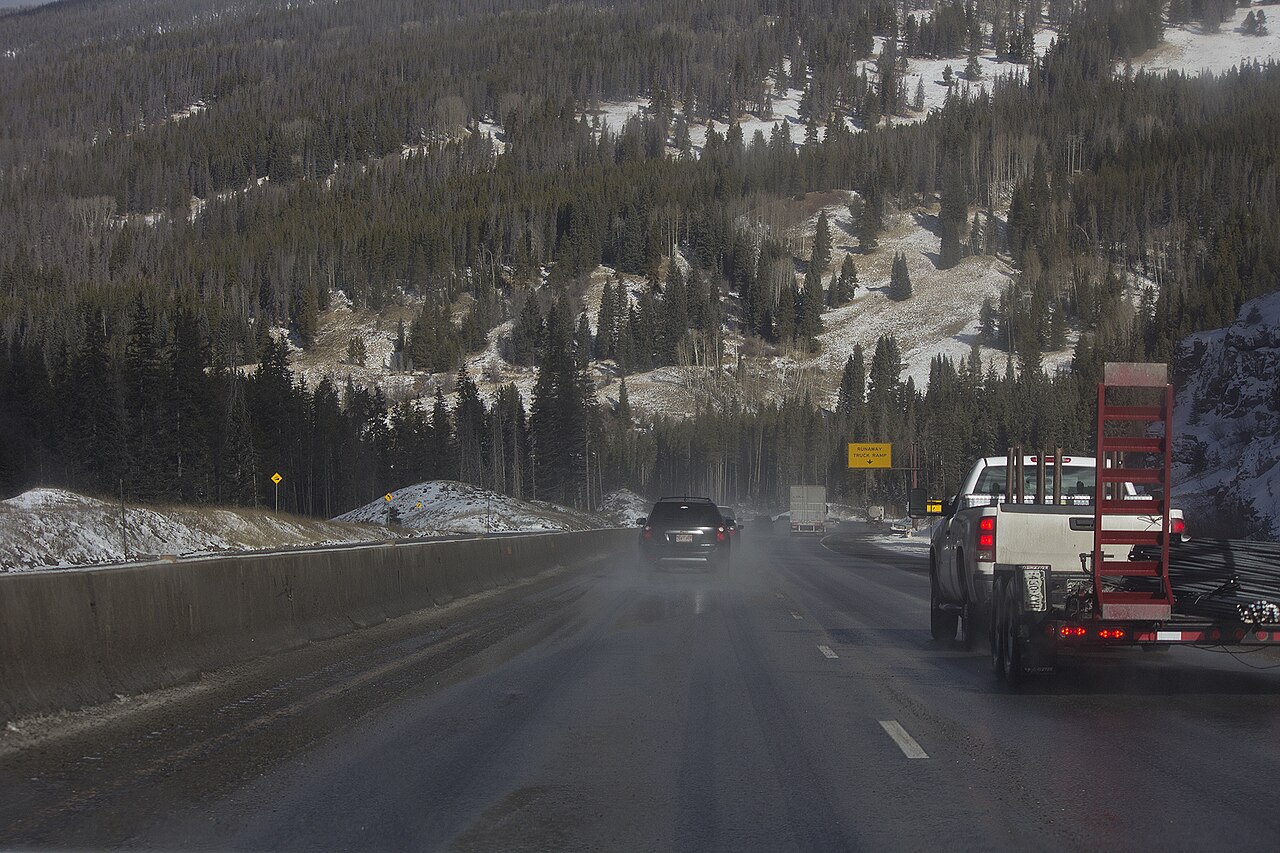
Interstate 70 westbound at Vail Pass, Colorado (Dec 3, 2012).
Interstate 70 westbound at Vail Pass, Colorado (Dec 3, 2012).Bidgee / Wikimedia Commons · CC BY-SA 3.0 AU (Creative Commons Attribution-ShareAlike 3.0 Australia)
00 Live conditions
Open
Temperature
46°F
Road
Clear
Weather
46°F, Clear
Northbound
No restrictions
Southbound
No restrictions

Reported Jun 2, 2026, 11:22 PM MT. Conditions change fast at elevation; confirm with the DOT before you commit.

01 Overview

Vail Pass tops out at 10,662 feet (3,250 m) and carries I-70 across Colorado between Vail and the Copper Mountain/Frisco side, through Eagle and Summit counties (Wikipedia). The interstate over the pass went in between 1973 and 1978. It was one of the harder pieces of I-70 to build, on par with the Eisenhower Tunnel and Glenwood Canyon. Rather than blast into unstable slopes, engineers split the lanes around a wide natural median and ran the road up on viaducts in places. This stretch looks different from the cut-rock corridor to the east.

Truckers respect Vail Pass because of the westbound drop off the summit. It runs about 10 miles. The signs read "7% grade next 7 miles," and the road holds near a sustained 7 percent for most of the way down, starting around milepost 189. Signs at the top warn "Steep grade next 8 miles, trucks stay in lower gear." About a half-mile west of the summit there is a 45 mph advisory for vehicles over 30,000 pounds. Two runaway truck ramps back up the descent. The first sits near milepost 185, about 4 miles below the top. The second sits near milepost 182, about 7-plus miles down (crashforensics.com).

This is also one of six I-70 sections CDOT flags as high-risk. As of August 2024, commercial vehicles over 16,000 pounds cannot run the left lane over Vail Pass except to pass (CDOT). The pass closes often in winter. The cost is real. I-70 in the mountains logged 99 full closures totaling 161 hours in 2024, an estimated $300 million hit with roughly $2 million lost per hour a road is shut (Colorado Sun, Mar 2025).

  • Summit 10,662 ft (3,250 m) on I-70, between Vail and Copper Mountain/Frisco (Wikipedia)
  • Westbound descent runs about 10 miles, signed "7% grade next 7 miles," near a sustained 7% from around milepost 189 (crashforensics.com)
  • Two westbound runaway truck ramps: near milepost 185 (about 4 miles down) and milepost 182 (7-plus miles down) (crashforensics.com)
  • 45 mph advisory for vehicles over 30,000 lb about a half-mile below the summit; trucks told to stay in low gear (crashforensics.com)
  • Commercial vehicles 16,000+ lb barred from the left lane except to pass, since August 2024 (CDOT)
  • I-70 in the mountains had 99 full closures totaling 161 hours in 2024, an estimated $300M impact, about $2M lost per hour (Colorado Sun, Mar 2025)
02 Chain controls & closures

September 1 to May 31 chain-control season; case-by-case closures, no fixed threshold

03 Notable hazards
Hazard

Sustained 7% westbound descent and brake fade

The roughly 10-mile drop off the summit is signed "7% grade next 7 miles" and stays near 7 percent for most of its length. Long downhill braking overheats truck brakes. Brake fade is a leading cause of runaways here. CDOT wants trucks holding about 45 mph over Vail Pass because their brakes alone cannot stop them at 65. Pick a low gear at the top and let the engine hold you back (crashforensics.com; Denver7).

Hazard

Runaway trucks and the escape ramps

Two gravel arrester-bed ramps catch out-of-control westbound trucks, near mileposts 185 and 182. They use clean round stone with no fines, which sucks a truck down like a ball pit instead of letting it skid. Brake-failure incidents on these grades peak in warm weather, not only winter. Colorado's most-used ramp sits on the same I-70 corridor at Lower Straight Creek (crashforensics.com; Denver7; Colorado Sun, Dec 2023).

Hazard

Winter whiteouts, ice and chain-law pileups

Heavy snow, ice and high-elevation whiteouts drive frequent traction- and chain-law enforcement and spin-outs. CSP tracks roughly 900 to 1,000 crashes a year on the I-70 mountain corridor, about 15 percent of them involving a commercial vehicle. A March 2025 storm pushed Vail to add its own fine for unchained vehicles during a surge in I-70 closures (Colorado Sun, Mar 21, 2025; CBS Colorado).

Hazard

Truck left-lane restriction zone

Since August 2024, with enforcement highlighted again in December 2025, commercial vehicles 16,000 pounds and up cannot use the left lane on Vail Pass except to pass. A violation runs about $100 and 4 license points. The rule targets steep, weather-hit grades where slow trucks and crashes block traffic (CDOT, Dec 2025; Colorado Sun, May 2, 2024).

Hazard

Traction-sand sediment in Black Gore Creek

Winter traction sand washes off the highway into Black Gore Creek, which runs alongside about 10 miles of I-70. Roughly 4,000 tons of sand reach the creek each year, with around 150,000 tons in the watershed. Black Gore Creek went on the state's 303(d) impaired-waters list for sediment in 2002, which led to sediment basins and a Basin of Last Resort (Vail Daily; Eagle River Coalition; USGS WRI 99-4270).

04 History

Named for Charles Vail (state highway director 1930 to 1945); first paved road 1940 with PWA funds, replacing Shrine Pass; I-70 built 1973 to 1978 with split lanes and viaducts; Black Lakes and rebuilt summit rest area (reopened 2025)

05 FAQ
How steep is the westbound grade on Vail Pass for trucks?
The westbound descent is about 10 miles and is signed "7% grade next 7 miles," holding near a sustained 7 percent for most of the drop. Other signs warn "Steep grade next 8 miles, trucks stay in lower gear." There is a 45 mph advisory for vehicles over 30,000 pounds about a half-mile below the summit (crashforensics.com; dangerousroads.org).
Where are the runaway truck ramps on Vail Pass?
There are two westbound gravel arrester-bed ramps. The first is near milepost 185, about 4 miles below the summit. The second is near milepost 182, about 7-plus miles down. They use clean round stone that traps a truck rather than letting it skid (crashforensics.com; Denver7).
Do truckers have to chain up on Vail Pass, and when?
Commercial vehicles over 16,000 pounds must carry chains on I-70 from September 1 to May 31 between Dotsero (MP 133) and Morrison (MP 259), which covers Vail Pass. When CDOT calls the Commercial Vehicle Chain Law, chains or ATDs go on the drive tires. Fines run about $500 for not carrying chains and up to roughly $1,000 to $1,157 for a chainless truck that blocks the road (CDOT 'Must Carry Law'; Colorado General Assembly).
Can trucks drive in the left lane over Vail Pass?
No. Since August 2024, commercial vehicles 16,000 pounds and up are restricted to the right lane on Vail Pass, and five other I-70 high-risk sections, except when passing. A violation is about $100 and 4 license points (CDOT, Dec 2025; Colorado Sun).
How often does I-70 close at Vail Pass?
There is no set schedule. CDOT and CSP close it case-by-case for storms, crashes, spun-out trucks, avalanche control and maintenance. I-70 in the mountains had 99 full closures totaling 161 hours in 2024, costing an estimated $300 million, about $2 million lost per hour of closure (Colorado Sun, Mar 2025).
What speed should a loaded truck hold descending Vail Pass?
CDOT wants trucks at about 45 mph over Vail Pass, and 35 mph through the nearby Eisenhower Tunnel, in a low gear. An official puts it plainly: their brakes alone cannot stop them at 65 mph on these grades, which is how brake fade turns into a runaway (Denver7; crashforensics.com).
06 Related routes

Vail Pass on the live map

See conditions, incidents, and weather around Vail Pass in real time.

Open Live Map