← All passes
Mountain pass No. 42 No live data

Cajon Pass

Cajon Pass carries I-15 between the San Bernardino Valley and the LA Basin on the south and the Mojave Desert, around Victorville and the Victor Valley, on the north. The road threads between the San Gabriel Mountains on the west and the San Bernardino Mountains on the east. One

4,260Elevation (ft)
1,298Metres
I-15Route
CAState
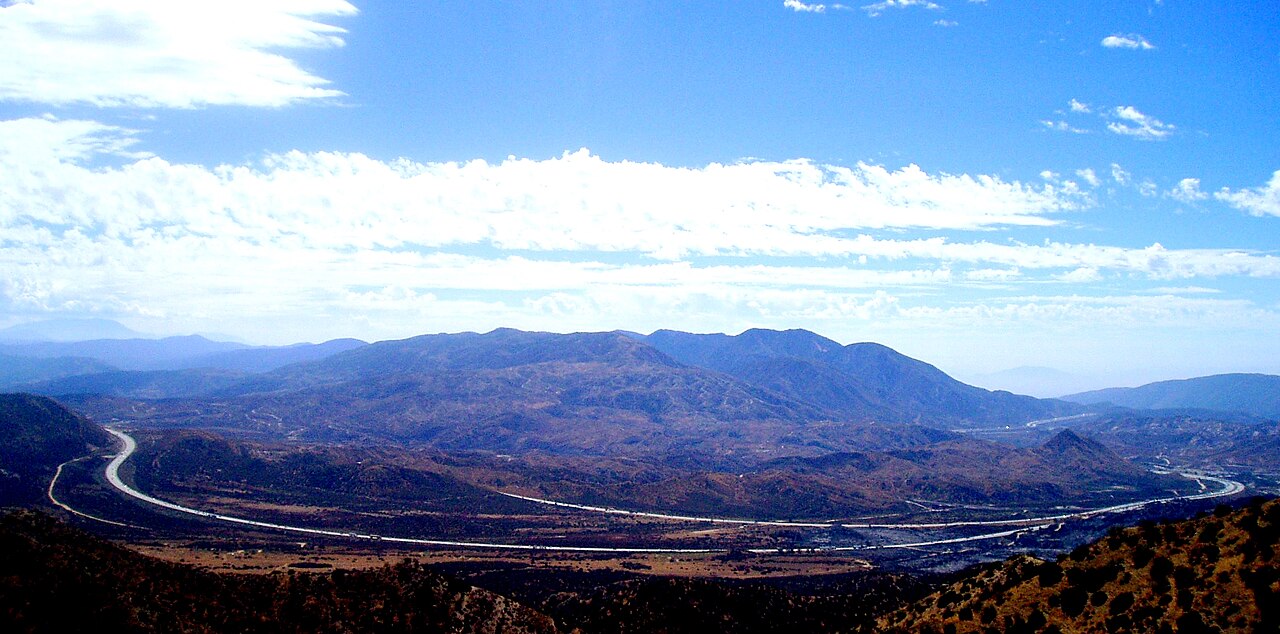
Wide-angle view of Interstate 15 passing over Cajon Summit in the San Bernardino National Forest (this is the lead/infobox image on the Cajon Pass Wikipedia article).
Wide-angle view of Interstate 15 passing over Cajon Summit in the San Bernardino National Forest (this is the lead/infobox image on the Cajon Pass Wikipedia article).jcookfisher (Flickr) / Wikimedia Commons · CC BY 2.0
00 Live conditions
No live data
No live condition feed for this pass right now. Check the state DOT or 511 before you climb.
01 Overview

Cajon Pass carries I-15 between the San Bernardino Valley and the LA Basin on the south and the Mojave Desert, around Victorville and the Victor Valley, on the north. The road threads between the San Gabriel Mountains on the west and the San Bernardino Mountains on the east. One thing trips people up. I-15 actually tops out at Cajon Summit, sign elevation about 4,260 ft, not at the geologic Cajon Pass proper at 3,777 ft (1,151 m). Locals and the signs call the whole corridor "Cajon Pass" anyway. The full run over the pass is roughly 60 miles (about 96 km) south to north between San Bernardino and Barstow (Dangerous Roads).

For trucks the number that matters is the descent. The controlling grade is about 6% sustained for roughly 4 miles, the truck speed limit is 45 mph, and cars run 70 (Dangerous Roads; Wikipedia). A southbound brake-check and safety area sits near Cajon Summit. A runaway-truck escape ramp is on the right about 2.5 miles down the southbound grade (4newsplus.com; VVNG.com). Get into a low gear before you start down. Do not wait until you smell your brakes.

This is also one of the highest truck-volume corridors in the western U.S., the main freight link from the Ports of LA and Long Beach to the interior. The corridor moves an estimated 30 million tons of cargo a year, most of it by truck (FreightWaves Classics; SBCTA). All of Cajon Pass is flagged as a freight bottleneck with over 15,000 annual vehicle-hours of truck delay, and I-15 congestion is estimated to cost over $3 billion per year (SBCTA). The pass is one of the busiest rail crossings in the country too. BNSF owns three tracks handling up to about 150 trains a day, plus one Union Pacific track, and Amtrak's Southwest Chief runs the BNSF line daily (Wikipedia).

  • Controlling grade is about 6% sustained for roughly 4 miles on the descent; truck speed limit 45 mph, cars 70 (Dangerous Roads; Wikipedia).
  • I-15 crests at Cajon Summit, sign elevation about 4,260 ft; the geologic Cajon Pass is 3,777 ft (1,151 m) (Wikipedia; Dangerous Roads).
  • Full run over the pass is roughly 60 miles (about 96 km), San Bernardino to Barstow (Dangerous Roads).
  • Brake-check and safety area near Cajon Summit; runaway-truck escape ramp about 2.5 miles down the southbound grade (4newsplus.com; VVNG.com).
  • Corridor moves an estimated 30 million tons of cargo a year, mostly by truck (FreightWaves Classics; SBCTA).
  • Named freight bottleneck: over 15,000 annual vehicle-hours of truck delay; congestion estimated over $3 billion per year (SBCTA).
  • Up to about 150 trains a day cross on three BNSF tracks plus one Union Pacific track (Wikipedia).
02 Chain controls & closures

Chain-control season runs with winter storms (commercial vehicles over 6,500 lb must carry chains Nov 1 to Apr 1). There is no fixed seasonal closure, but the pass closes often on wind, crashes, fires, snow, and wildfire.

03 Notable hazards
Hazard

Brake overheating and runaway trucks on the 6% downgrade

The sustained 6% grade over about 4 miles overheats brakes and builds momentum on loaded rigs. That produces brake fires, runaway trucks, and rear-end pileups. There is a brake-check area near Cajon Summit and a runaway-truck escape ramp about 2.5 miles down the southbound grade. A July 26, 2024 southbound incident began as a reported brake fire on a tractor-trailer around 4:52 AM, spread to the tires and then the whole semi, closed lanes, and triggered a SIG alert. Get into a low gear before you descend, use engine braking, and watch your brake temps (VVNG.com; 4newsplus.com; RMDLAW).

Hazard

Santa Ana and canyon winds toppling high-profile and empty trucks

Gusts through the pass and the funnel below it, around Devore, Glen Helen, and Sierra Ave in Fontana, commonly reach 60-plus mph, and Santa Ana events can top 80 mph. They blow over semis, and empty or lightly loaded trailers go first. On January 8, 2025 an overturned semi on the 210-to-southbound-I-15 ramp killed the driver, and a single Santa Ana event toppled at least four big rigs on the 15 near the pass. Slow down or wait it out when CHP issues a wind advisory (Wikipedia; KTLA; ABC7; VVNG.com).

Hazard

Sunday and holiday Las Vegas-return traffic surges

Vegas travel is heaviest Sunday afternoon and evening heading back to LA, and it stacks passenger congestion on top of constant heavy truck traffic. One stall, crash, or wind incident on the grade then cascades into long backups. The pass is a named freight bottleneck with over 15,000 annual vehicle-hours of truck delay, so there is little slack to absorb a problem (i15highway/traffic guides; SBCTA).

Hazard

Wildfire crossing the corridor

Fast-moving fires hit the pass repeatedly. The July 17, 2015 North Fire jumped I-15 and burned more than 20 vehicles abandoned on the freeway. The August 16, 2016 Blue Cut Fire destroyed a Union Pacific rail trestle and the historic Summit Inn and forced freeway closures and evacuations (Wikipedia).

04 History

The San Andreas Fault carved the pass and crosses I-15 just south of Cajon Summit. Mormon settlers crossed by wagon in 1851. The name is Spanish for box or drawer. Rail came through in the 1880s, Route 66 ran here from 1926 to 1979, and I-15 opened over the summit in 1969. The steep grade has a long record of rail runaways and derailments (1989, 1994, 1996).

05 FAQ
How steep and how long is the Cajon Pass downgrade on I-15?
The controlling grade is about 6% sustained for roughly 4 miles. The truck speed limit is 45 mph and cars run 70. I-15 tops out at Cajon Summit, sign elevation about 4,260 ft, while the geologic Cajon Pass sits at 3,777 ft. There is a brake-check area near the summit and a runaway-truck ramp about 2.5 miles down the southbound grade (Dangerous Roads; Wikipedia; VVNG/4newsplus).
When are chains required on I-15 over Cajon Pass, and what do R-1, R-2, and R-3 mean?
Caltrans posts chain controls during winter storms between Victorville and San Bernardino. R-1: chains on all vehicles except cars and light trucks under 6,000 lb with snow tires on two drive wheels, and trailers chain one axle. R-2: chains on all except 4WD/AWD with snow tires on all four wheels. R-3: chains on everything. Speed drops to 25 to 30 mph. Commercial trucks over 6,500 lb must carry chains on designated routes November 1 to April 1. Check Caltrans QuickMap or call 1-800-427-7623 (Caltrans Chain Requirements).
Why do trucks catch fire or run away on Cajon Pass?
The 6% grade for 4 miles overheats brakes on loaded rigs. Riding the brakes instead of dropping into a low gear and using engine braking causes brake fade, fires, and runaways. The July 26, 2024 southbound tractor-trailer fire started as a reported brake fire and spread to the whole truck. Get into a low gear before you start down, watch your brake temps, and know the runaway ramp is about 2.5 miles down (RMDLAW; VVNG.com).
Is Cajon Pass dangerous in high winds for semis?
Yes. Gusts routinely hit 60-plus mph and Santa Ana events can top 80 mph through the pass and the funnel below it at Devore, Glen Helen, and Sierra Ave. Empty and high-profile trailers blow over most easily. One Santa Ana event flipped at least four big rigs near the pass, and a January 8, 2025 overturn on the 210-to-southbound-15 ramp killed the driver. Slow down or wait it out when CHP issues a wind advisory (KTLA; ABC7; Wikipedia).
When is traffic worst on I-15 through Cajon Pass?
Sunday afternoon and evening, when Las Vegas-return traffic to LA piles on top of steady heavy truck volume. Weekends surge with Vegas travel both directions. The pass is a named freight bottleneck with over 15,000 annual vehicle-hours of truck delay, so any incident on the grade cascades into long backups (i15highway/traffic guides; SBCTA).
Does the San Andreas Fault really cross the highway here?
Yes. The San Andreas Fault, the Pacific and North American plate boundary, created the pass and crosses I-15 just south of Cajon Summit. The pass is also a top U.S. rail corridor: BNSF runs up to about 150 trains a day on three tracks, plus one Union Pacific track (Wikipedia; USGS).
06 Related routes

Cajon Pass on the live map

See conditions, incidents, and weather around Cajon Pass in real time.

Open Live Map