← All passes
Mountain pass No. 57 No live data

Bozeman Pass

Bozeman Pass carries I-90 over the gap between the Bridger Range to the north and the Gallatin Range to the south, on the Gallatin and Park county line in southwestern Montana. It sits about 13 miles east of Bozeman and about 15 miles west of Livingston. The summit runs roughly 5

5,712Elevation (ft)
1,741Metres
I-90Route
MTState
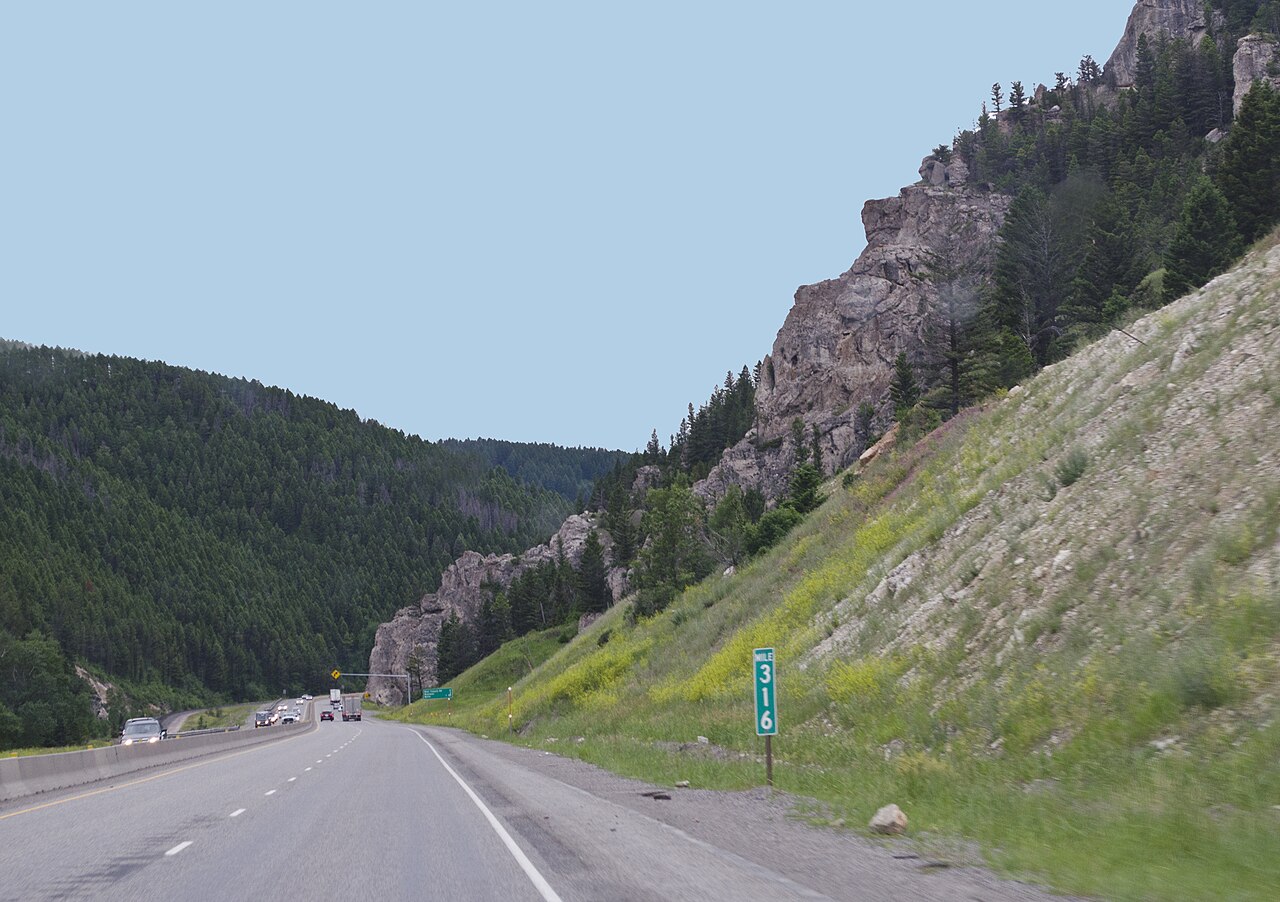
Looking west along Interstate 90 as it climbs through Bozeman Pass in southwestern Montana.
Looking west along Interstate 90 as it climbs through Bozeman Pass in southwestern Montana.Tim Evanson / Wikimedia Commons · CC BY-SA
00 Live conditions
No live data
No live condition feed for this pass right now. Check the state DOT or 511 before you climb.
01 Overview

Bozeman Pass carries I-90 over the gap between the Bridger Range to the north and the Gallatin Range to the south, on the Gallatin and Park county line in southwestern Montana. It sits about 13 miles east of Bozeman and about 15 miles west of Livingston. The summit runs roughly 5,700 ft. Sources put it between about 5,702 ft on the USGS gap reading and about 5,760 ft where I-90 crosses, so treat it as a high climb without trusting any single false-precision number. The National Weather Service labels its forecast point here "Bozeman Pass I-90 MP 321.8," and the grade sits between Bear Canyon Rd at Exit 313 and Jackson Creek Rd at Exit 319.

This is one of the higher I-90 climbs in Montana and a recurring winter chokepoint. It closes again and again through the cold months for blowing snow, whiteout visibility, black ice, and the crashes that follow. The Livingston end is some of the worst high-wind road in the state, and trucks get blown over there. There is no avalanche risk documented for the pass itself, so do not let the elevation fool you into expecting one.

The climb from the Livingston side runs roughly 12 miles by secondary accounts, though MDT does not publish a confirmed maximum highway grade. Gear down for the descent and treat it as a long, sustained grade rather than quoting a hard percent that no DOT source backs. Before you run it, pull the live status from MDT 511 and the NWS point forecast. The pass has no scheduled closures; it shuts without warning, and the only reliable way to know is to check.

  • Crosses I-90 between Bozeman and Livingston, at the Gallatin and Park county line, about 13 miles east of Bozeman (Wikipedia, citing USGS GNIS)
  • Summit runs roughly 5,700 ft; sources range from 5,702 ft at the USGS gap to about 5,760 ft where I-90 crosses (Wikipedia)
  • Separates the Bridger Range to the north from the Gallatin Range to the south (Wikipedia)
  • NWS forecast point is labeled Bozeman Pass I-90 MP 321.8, with the grade between Exit 313 and Exit 319 (NWS Great Falls)
  • Not the highest pass on I-90 in Montana; Homestake Pass at about 6,375 ft is higher (Wikipedia)
  • MDT lists Bozeman Hill among its designated chain-up locations on I-90, alongside Lookout Pass, Homestake Pass, and Cardwell Hill (MDT chains.aspx)
  • No scheduled closures and no reliable annual closure count; it shuts event by event during winter storms and high wind
02 Chain controls & closures

Montana has no fixed chain-control season the way California does. MDT can require chains at any time of year once it declares dangerous conditions in a designated area. Between October 1 and April 30, towing units of 26,001 lbs GVW or greater must carry tire chains or an MDT-approved traction device when running where chains may be required. AutoSock counts as an approved alternative. When chains are declared in effect, every vehicle towing a trailer must put chains on the driver wheels of at least one axle. Four-wheel-drive vehicles are exempt from the carry rule. There is no fixed open or close date for the pass itself. It opens and closes ad hoc as MDT reacts to storms, then reopens once conditions and any wrecks clear. Watch for the posted chain-up and removal signs on Bozeman Hill rather than expecting a published mile marker, since MDT does not publish a specific chain-up pullout location for the grade. (MDT chains.aspx)

03 Notable hazards
Hazard

Winter whiteouts shut the pass

The grade closes again and again for blowing snow, dropped visibility, and snow-packed or icy lanes, and chain-reaction crashes are common. On February 5, 2025, MDT closed I-90 through the pass from about a mile east of Jackson Creek into Livingston, roughly MM 313 to 330, for blowing snow and low visibility, then reopened it that afternoon around 2:45 p.m. (KBZK; MDT 511)

Hazard

Wind flips semis near Livingston

The Livingston end of the pass is one of Montana's worst high-wind corridors. NWS issues advisories with southwest winds of 30 to 40 mph gusting near 60 mph, and trucks get blown over here. In one March 2026 event, high winds closed I-90 and two semis went over near Livingston, one landing on a sheriff's deputy's vehicle. Slow down or shut down a high-profile load. (NBC Montana; KBZK; NWS)

Hazard

It snows here in May

The danger is not limited to deep winter. A storm on May 7 and 8, 2024 dropped 7 to 11 inches of snow over the pass, set off a string of crashes across about 12 hours, and left some drivers stranded more than seven hours. Carry your chains and watch the forecast in the shoulder seasons. (Livingston Enterprise; snow totals from NWS Billings)

Hazard

Long grade, fast pileups

The sustained climb and descent combined with winter road surfaces produces multi-vehicle wrecks that close the highway outright. MDT has shut the pass on wreck alone, not just weather. Keep your following distance up and gear down before the descent. (Billings Gazette; NBC Montana)

04 History

Long before the interstate, this gap was a travel route. William Clark's party crossed the pass on July 15, 1806, guided by Sacagawea, while exploring the Yellowstone River on the return leg of the Lewis and Clark Expedition. The pass takes its name from pioneer John Bozeman, who opened the Bozeman Trail in 1863 to run from Fort Laramie, Wyoming, up to the gold camps around Virginia City, Montana.

The railroad came next, and it came underground. The first train ran through the Northern Pacific Railway tunnel under the pass on January 20, 1884, after the east and west headings met the previous December; engineer W. Milnor Roberts had picked the route. A fire blamed on a passing engine broke out inside the tunnel on September 13, 1895, and the damaged bore was out of service for about a year before trains ran again through the rebored tunnel by mid-1896. A newer, shorter tunnel just north of the original opened on July 28, 1945, and the last train ran the 1884 bore that day; the tracks today belong to BNSF Railway. I-90 was built over the pass in the 1960s. (Wikipedia, Bozeman Magazine)

05 FAQ
Does Bozeman Pass require chains for trucks?
It can, any time MDT declares the conditions for it, because Montana has no fixed chain season. Between October 1 and April 30, towing units of 26,001 lbs GVW or greater have to carry tire chains or an MDT-approved traction device when running where chains may be required; AutoSock is an approved alternative. When chains are declared in effect, towing units chain the driver wheels of at least one axle. Watch for the posted chain-up signs on Bozeman Hill. (MDT chains.aspx)
How high is Bozeman Pass, and is it the highest on I-90 in Montana?
It runs roughly 5,700 ft, with sources reading from about 5,702 ft at the USGS gap to about 5,760 ft where I-90 crosses. It is not the highest. Homestake Pass on I-90, at about 6,375 ft, sits higher. (Wikipedia)
Why does I-90 close so often over the pass in winter?
Blowing snow and whiteouts, black ice, and high crosswinds set off crashes, and MDT closes the road event by event, then reopens once it clears. Recent examples are the February 5, 2025 closure for blowing snow and a spring storm on May 7 and 8, 2024. There is no reliable annual closure count. (KBZK; Livingston Enterprise)
Is the wind really that bad near Livingston?
Yes. NWS issues advisories with gusts near 60 mph, and there are documented events of semis blown over, including one that landed on a deputy's vehicle. If you are running a high-profile load, slow down or park it until the wind drops. (NBC Montana; NWS)
How long is the climb and how steep is it?
Secondary accounts put the Livingston-side climb at roughly 12 miles. MDT does not publish a confirmed maximum highway grade percent in the sources I could check, so do not trust a hard number you might see quoted. Treat it as a long, sustained grade and gear down for the descent.
Where do I check conditions before crossing?
Use MDT 511 at 511mt.net for road status and closures, and pull the NWS Great Falls point forecast labeled Bozeman Pass I-90 MP 321.8 for wind and snow. The pass has no scheduled closures, so checking live is the only way to know before you run it. (MDT; NWS)
06 Related routes

Bozeman Pass on the live map

See conditions, incidents, and weather around Bozeman Pass in real time.

Open Live Map