← All passes
Mountain pass No. 84 Open

Teton Pass

Wyoming Highway 22 climbs over Teton Pass to connect Jackson, Wyoming with Idaho State Highway 33 near Victor, Idaho. The summit sign reads 8,431 feet (Wikipedia lists 8,435 ft), and the whole state highway runs 17.494 miles. From the base near Wilson on the Wyoming side, the roa

8,431Elevation (ft)
2,570Metres
WY-22Route
WYState
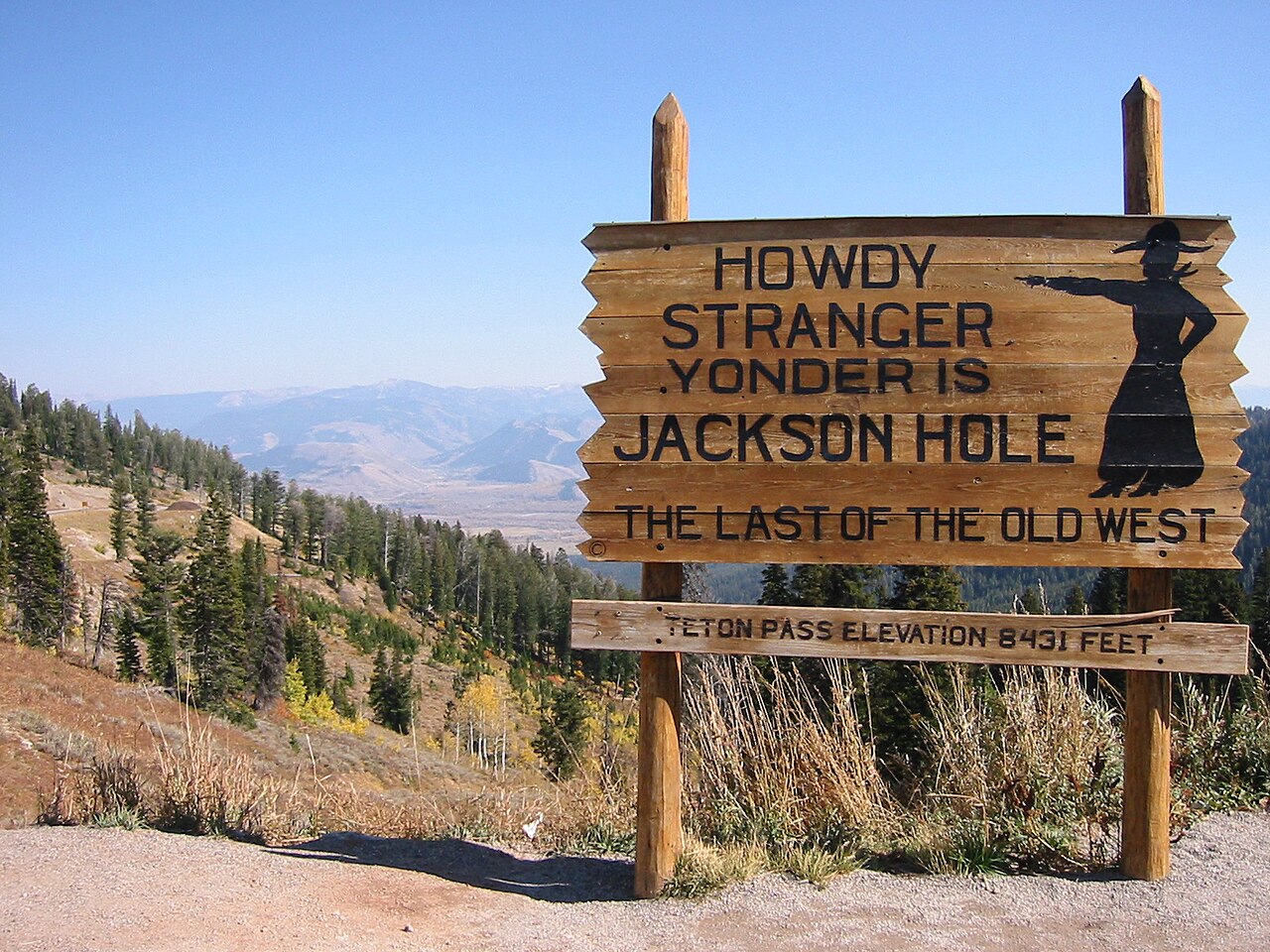
The roadside summit sign on Wyoming Highway 22 at Teton Pass reading 'Yonder Lies Jackson Hole' with the 8431-ft elevation marker.
The roadside summit sign on Wyoming Highway 22 at Teton Pass reading 'Yonder Lies Jackson Hole' with the 8431-ft elevation marker.Dhtrible (Wikimedia Commons) · CC BY-SA 3.0 (also GFDL 1.2+)
00 Live conditions
Open
Temperature
45°F
Road
Clear
Weather
45°F, Clear
Northbound
No restrictions
Southbound
No restrictions

Reported Jun 2, 2026, 11:23 PM MT. Conditions change fast at elevation; confirm with the DOT before you commit.

01 Overview

Wyoming Highway 22 climbs over Teton Pass to connect Jackson, Wyoming with Idaho State Highway 33 near Victor, Idaho. The summit sign reads 8,431 feet (Wikipedia lists 8,435 ft), and the whole state highway runs 17.494 miles. From the base near Wilson on the Wyoming side, the road gains about 2,400 feet to the top. From the west terminus it climbs over 1,700 feet in 6.4 miles along Trail Creek. This is not a relaxed mountain road. The original 1960s alignment holds a sustained 10 percent grade, among the steepest of any major US highway, and the temporary detour built after the 2024 landslide is graded steeper still at 11.2 percent.

Teton Pass is a commuter corridor first and a freight route second, and the rules show it. A 60,000 lb maximum weight restriction applies at all times on WY 22 between Wilson and the Idaho state line. No trailers of any kind are allowed over the pass between November 15 and April 1 each winter. WYDOT reports an Annual Average Daily Traffic near 10,000 vehicles, with summer peaks up to 15,000. Roughly 3,000-plus Idaho residents drive over the pass to work in Jackson Hole every day because of Jackson's housing costs. When the pass closes, that traffic faces a 60-plus-mile detour, which is why a Teton Pass shutdown lands hard on both sides of the line.

Winter on the pass is mostly about snow on the slopes above the road. WYDOT manages about 70 avalanche paths along the corridor. The two that most directly threaten the highway are Glory Bowl and Twin Slides on Mount Glory. Those two close the road most often for control work. The bigger lesson of recent years came in summer. On June 8, 2024 a section of the road at milepost 12.8 slid off the mountain after rapid snowmelt saturated the clay beneath the fill, severing WY-22 for 20 days.

  • WY 22 runs 17.494 miles over Teton Pass between Jackson, WY and Idaho SH 33 near Victor, ID (Wikipedia)
  • Summit 8,431 ft per the roadside sign; Wikipedia lists 8,435 ft
  • Sustained 10 percent grade on the original road, 11.2 percent on the post-2024 detour, among the steepest of any major US highway (Wikipedia, Wyoming Highway 22)
  • 60,000 lb maximum weight at all times between Wilson and the Idaho state line; no trailers Nov 15 to Apr 1 (Wyoming Highway Patrol)
  • Annual Average Daily Traffic near 10,000 vehicles, up to 15,000 in summer; roughly 3,000-plus Idaho commuters cross daily (WYDOT collapse media kit; Mountain Journal)
  • About 70 avalanche paths along the corridor; Glory Bowl and Twin Slides on Mount Glory directly threaten the road (Jackson Hole News&Guide)
  • On June 8, 2024 the road at milepost 12.8 collapsed in a landslide and was severed for 20 days, forcing a 60-plus-mile detour (WYDOT collapse media kit)
02 Chain controls & closures

Wyoming's two-level chain law applies to WY-22 over Teton Pass. WYDOT declares it when snow and ice make conditions hazardous, through the snow months. A Level 1 was posted as early as November 26 in 2025. Level 1 restricts travel to vehicles with tire chains, adequate mud/snow or all-weather tires, or all-wheel drive. Level 2 is for extremely hazardous conditions. All commercial vehicles have to run chains on at least two drive wheels at opposite ends of the same drive axle, installed in the designated chain-up areas signed on the corridor. WYDOT's published Teton Pass guidance does not name specific chain-up turnouts, so use the signed chain areas. Fines are $250 for violating a travel or chain restriction and $750 for a violation that results in a highway closure. Two rules apply on top of the chain law: no trailers of any kind over the pass between November 15 and April 1, and a 60,000 lb maximum weight year-round between Wilson and the Idaho line.

Closures here are condition-driven, not calendar-driven. The pass stays open in winter when conditions allow, so there is no fixed seasonal full closure. The most common and most predictable closures are for avalanche control. Crews close the road, trigger slides on Glory Bowl, Twin Slides and other paths with remote systems (Avalanche Guard explosive pucks, Gasex exploders) and artillery historically, then clear the debris. Control closures usually run a few hours but can stretch longer when a slide buries the road. Natural avalanches, mud and rockslides, and severe winter storms with no-unnecessary-travel advisories also force closures. A February 2017 avalanche cycle closed the pass for about five days. The exception was the June 2024 landslide, which fully severed the road for 20 days. Check WYDOT's wyoroad.info and the WYO 22 webcams and alerts before you cross.

03 Notable hazards
Hazard

Catastrophic landslide and slope failure

The downhill fill supporting WY-22 at milepost 12.8 slid off the mountain on June 8, 2024 after rapid snowmelt saturated and lubricated the underlying clay. WYDOT called it catastrophic and unavoidable, with no slope movement detected two weeks earlier. The road was fully severed for 20 days and the detour ran more than 60 miles. (WYDOT collapse media kit; Cowboy State Daily, May 3, 2025; EOS Landslide Blog)

Hazard

Avalanches crossing the highway

About 70 avalanche paths are managed along the corridor. Glory Bowl and Twin Slides off Mount Glory directly threaten the road and are the most active. Slides regularly close the pass for control work. The only WYDOT-era road fatality came in 1956 at Crater Lake from a Glory Bowl slide. (Jackson Hole News&Guide; Bridger-Teton Avalanche Center)

Hazard

Sustained 10 percent grade with sharp curves

The original 1960s road holds a roughly 10 percent sustained grade, and the post-2024 detour is 11.2 percent, among the steepest on any major US highway. With sharp curves on top of that, it demands real brake management on the downgrade for heavy trucks. Gear down before the descent. (Wikipedia, Wyoming Highway 22; Wyoming Highway Patrol)

Hazard

Winter ice, snow and fast weather changes

Heavy snowfall, ice and high-elevation storms make the climb hazardous. WYDOT activates the chain law and issues no-unnecessary-travel advisories. Trailers are banned November 15 to April 1, and a 60,000 lb weight cap applies year-round. (Wyoming Highway Patrol; Buckrail chain-law explainer)

Hazard

Mud and debris flows in spring

Spring snowmelt can drive mudslides onto the road. A slide at milepost 15 buried the highway in mud just before the June 2024 collapse, and a separate crack at milepost 12.8 was struck by a motorcyclist before the failure. (Jackson Hole News&Guide, 'Mudslide, crack cripple Teton Pass')

04 History

A route over Teton Pass long predates the modern road, used as a wagon and stage crossing between Jackson Hole and Idaho's Teton Valley. The highway truckers drive today was built in the 1960s with the sustained 10 percent grade it still carries. Avalanche control on highways near Jackson goes back to 1972, when WYDOT first used artillery to knock down slide hazard. Control on Teton Pass now relies on remote systems (Avalanche Guard, Gasex) and infrasonic detection trained on Glory Bowl and Twin Slides.

The defining recent event is the 2024 collapse. On June 8, 2024 a section of WY-22 at milepost 12.8 slid off the mountain after rapid warming melted the snowpack and saturated the clay under the road fill. Governor Mark Gordon declared an emergency, and the US DOT released $6 million in Quick Release emergency funds. A temporary detour reopened the pass on June 28, 2024, 20 days after the slide. The permanent reconstruction (about $11M of slope stabilization, $30M of drainage and base work, and a $1.4M box culvert) was expected to finish in July 2025, with a final weekend closure planned that year.

05 FAQ
Can semi-trucks and trailers use Teton Pass on WY-22?
A 60,000 lb maximum weight restriction is in effect at all times between Wilson, WY and the Idaho state line, and no trailers of any kind are allowed over the pass between November 15 and April 1 each winter. Even outside that window, the weight cap rules out most loaded combination trucks. Source: Wyoming Highway Patrol Mountain Road Information.
How steep is Teton Pass and how long is the grade?
The original 1960s road carries a sustained grade of about 10 percent, and the post-2024 detour is 11.2 percent, among the steepest on a major US highway. The Wyoming side climbs roughly 2,400 feet from near Wilson to the 8,431-ft summit. The Idaho side rises over 1,700 feet in about 6.4 miles. Source: Wikipedia, Wyoming Highway 22; Wyoming Highway Patrol.
When does the chain law go into effect on Teton Pass, and what does it require?
WYDOT declares Wyoming's two-level chain law whenever snow and ice make WY-22 hazardous. A Level 1 was posted as early as November 26 in 2025. Level 1 requires chains, adequate snow or all-weather tires, or AWD. Level 2 requires commercial vehicles to chain at least two drive wheels at opposite ends of the same drive axle, installed in the designated chain areas. Fines are $250, or $750 if a violation causes a closure. Source: Buckrail chain-law explainer; County 10.
Is Teton Pass open right now, or could it close suddenly?
The pass stays open in winter when conditions allow, but it closes on short notice for avalanche control, often for a few hours, and for storms, mudslides or natural slides. WYDOT manages about 70 avalanche paths along the corridor. Check WYDOT's wyoroad.info, the WYO 22 webcams and the alerts before you cross. Source: Jackson Hole News&Guide; Buckrail; WYDOT.
What happened to Teton Pass in 2024, and is it fixed?
On June 8, 2024 a section at milepost 12.8 slid off the mountain after rapid snowmelt saturated the clay beneath the road fill. WYDOT called it catastrophic but unavoidable. A temporary detour reopened the pass 20 days later on June 28, 2024, and the permanent rebuild was slated to finish around July 2025. Source: WYDOT collapse media kit; Cowboy State Daily.
Why is Teton Pass so busy with commuters?
WYDOT reports an Annual Average Daily Traffic near 10,000 vehicles, with summer peaks up to 15,000. Thousands of workers, commonly cited around 3,000-plus, drive over the pass daily from Victor and Driggs, Idaho into Jackson Hole because of Jackson's high housing costs. That is why a closure forces a 60-plus-mile detour and disrupts both valleys. Source: WYDOT collapse media kit; Mountain Journal; jhnewsandguide.com.
06 Related routes

Teton Pass on the live map

See conditions, incidents, and weather around Teton Pass in real time.

Open Live Map