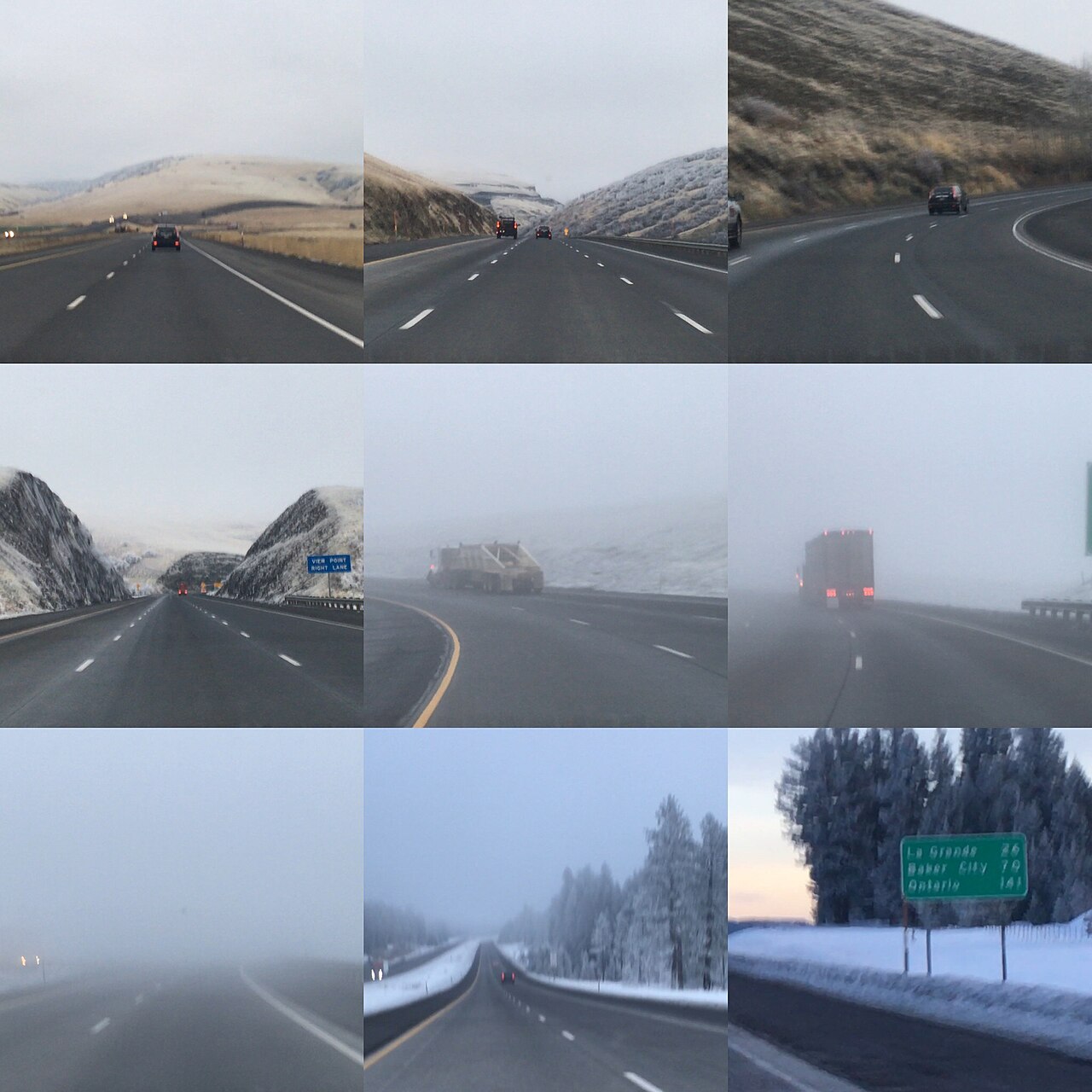
Cabbage Hill is the steep western descent on I-84 where the freeway drops off the Blue Mountains in eastern Oregon. The road climbs and falls between Pendleton at the northwest base and La Grande to the southeast. ODOT's trucker brochure puts the downgrade about 35 miles west of La Grande. The official name is Emigrant Hill, drivers call it Cabbage Hill, and the wider area carries the name Deadman Pass.
Westbound is the side that gets respect. ODOT describes a seven-mile downgrade where you lose about 2,000 feet of elevation in six miles and twist through a double hairpin turn at a 6-percent downgrade. The signed grade runs from Milepost 227 down to Milepost 217. Going east, I-84 climbs roughly 3,000 feet up a series of switchbacks with a maximum grade of 5 to 6 percent, per the sourced Wikipedia article on Interstate 84 in Oregon. The lanes are split by a wide median for about eight miles through the steep section.
Truckers care because the combination is hard to manage: a sustained 6-percent grade, two hairpins, and weather that turns fast. ODOT calls it some of the most changeable and severe weather in the Northwest, with fog, snow, and black ice common from October through April. The hill has a long crash record, and ODOT's own numbers show out-of-state carriers and brake problems show up again and again. It is widely regarded as one of the most hazardous truck descents in the Pacific Northwest.
- Westbound downgrade runs Milepost 227 to Milepost 217, signed as a seven-mile, 6-percent grade (ODOT brochure)
- You drop about 2,000 feet in six miles and pass through a double hairpin turn (ODOT brochure)
- Eastbound, I-84 climbs roughly 3,000 feet on switchbacks at a max grade of 5 to 6 percent (Wikipedia, Interstate 84 in Oregon)
- Two runaway truck escape ramps sit at Milepost 221.97 and Milepost 220.11 (ODOT brochure)
- On average 78 percent of Cabbage Hill crashes involve out-of-state motor carriers (ODOT brochure)
- On average 59 percent of brake problems contribute to accidents on the hill (ODOT brochure)
- Fog, snow, and black ice are common between October and April (ODOT brochure)