← All passes
Mountain pass No. 43 Chains

Siskiyou Summit

Siskiyou Summit is the high point of Interstate 5. At 4,310 feet, it is the tallest spot the freeway hits over its roughly 1,381 miles from the Mexican border to the Canadian one (Oregon DOT, via Wikipedia). The summit sits in the Siskiyou Mountains about 12 miles south of Ashlan

4,310Elevation (ft)
1,314Metres
I-5Route
ORState
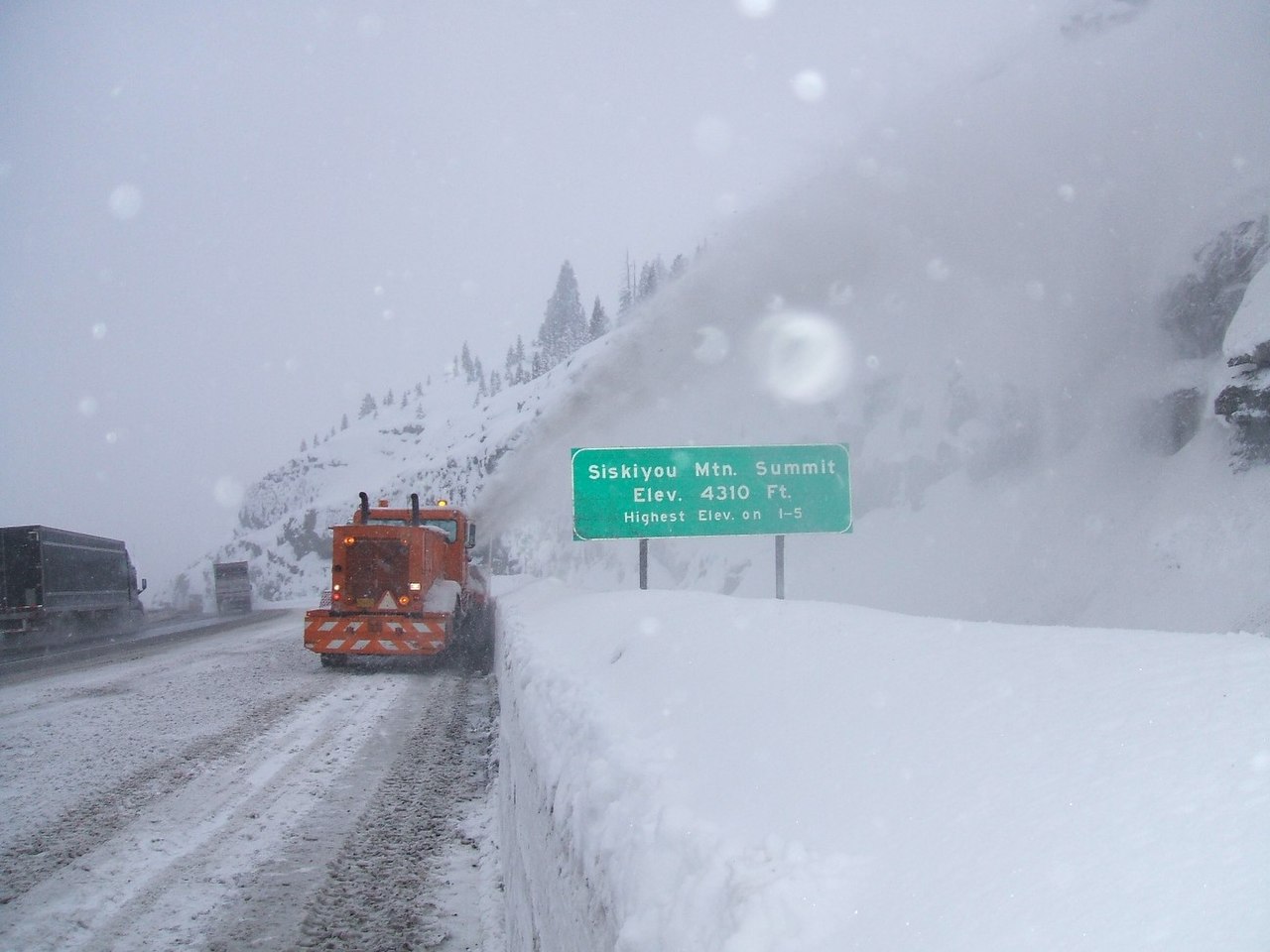
Oregon DOT crews work to clear Siskiyou Summit on Interstate 5 during a winter storm (photo Oct 10, 2008).
Oregon DOT crews work to clear Siskiyou Summit on Interstate 5 during a winter storm (photo Oct 10, 2008).Oregon Department of Transportation (via Oregon DOT Flickr; uploaded to Commons by User:Smallman12q) / Wikimedia Commons · CC BY 2.0
00 Live conditions
Chains
Temperature
96°F
Road
Wet
Weather
Clear
Northbound
Carry Chains
Southbound
Carry Chains

Reported Apr 25, 2026, 4:58 AM MT. Conditions change fast at elevation; confirm with the DOT before you commit.

01 Overview

Siskiyou Summit is the high point of Interstate 5. At 4,310 feet, it is the tallest spot the freeway hits over its roughly 1,381 miles from the Mexican border to the Canadian one (Oregon DOT, via Wikipedia). The summit sits in the Siskiyou Mountains about 12 miles south of Ashland, Oregon. It is around 4 miles north of the California line and about 25 miles north of Yreka. More than 13,000 vehicles a day run this stretch, and ODOT says roughly half the vehicles in crashes here were commercial trucks pulling trailers.

The northbound side is what bites. From the top, a loaded rig drops about 2,300 feet in roughly 6 miles on a sustained 6 percent grade through sharp curves. It is often called the steepest grade anywhere on I-5 (dangerousroads.org). Brakes that come down hot turn into runaways. That is why ODOT built two escape ramps on the descent, at Milepost 6.3 and Milepost 9.5. Check your brakes before you start down. Pick a speed you can hold, and stay in low gear.

Weather makes the grade worse. Fog, snow, and black ice are common from October through April. The north-side descent is known for fog dropping visibility to almost nothing, especially at night. Truck inspection and chain-check sites sit at Milepost 1 northbound and Milepost 11 southbound, with chain-up areas set ahead of them so you have shoulder room to get your chains on before the snow line. Show up at the inspection site without chains fully on and you get turned around.

  • Highest point on Interstate 5 at 4,310 ft (1,314 m), over the freeway's full ~1,381-mile run (Oregon DOT, via Wikipedia)
  • Northbound descent drops about 2,300 ft in roughly 6 miles on a sustained 6 percent grade (ODOT Respect the Pass)
  • Often called the steepest grade on I-5 (dangerousroads.org)
  • More than 13,000 vehicles a day use this stretch; about half the vehicles in crashes here were commercial trucks with trailers (ODOT Respect the Pass)
  • Two northbound runaway-truck escape ramps, at Milepost 6.3 and Milepost 9.5 (ODOT Respect the Pass)
  • Inspection and chain-check sites at Milepost 1 northbound and Milepost 11 southbound, with chain-up areas set ahead of them (ODOT Respect the Pass)
  • Fog, snow, and black ice common October through April, with fog cutting visibility to near zero on the north-side descent (ODOT Respect the Pass; dangerousroads.org)
02 Chain controls & closures

October through April, no fixed closure date; reactive conditional closures and full closures during storms

03 Notable hazards
Hazard

Sustained 6 percent downgrade with brake-failure risk

Northbound, trucks drop about 2,300 ft in roughly 6 miles at a 6 percent grade through sharp curves. ODOT tells drivers to check brakes before the descent, pick a safe speed, and come down in low gear. Overheated brakes lead to runaways, which is why two escape ramps exist, at MP 6.3 and MP 9.5 (ODOT Respect the Pass).

Hazard

Dense fog and near-zero visibility

The north-side descent is known for fog, especially at night, with visibility dropping to almost nothing. Fog stacked on top of the grade and the curves is why this stretch sees so many wrecks (dangerousroads.org; ODOT Respect the Pass).

Hazard

Snow, ice, and black ice

Heavy snow and freezing rain hit October through April. Fresh morning snow under early sun is the slickest, and black ice forms as overnight temperatures drop. Mid-day is usually the safest time to cross (ODOT Respect the Pass; dangerousroads.org).

Hazard

Jackknifed and chained-up-too-late trucks

ODOT warns it is better to chain up early than to chain up after you jackknife. About half the vehicles in crashes on this stretch were commercial trucks with trailers, and jackknifed rigs repeatedly block lanes during storms (ODOT Respect the Pass; KVAL News).

Hazard

Multi-vehicle ice pileups near the state line

On the California side between Yreka and Hornbrook, just south of the border, ice in freezing, foggy weather set off a 60-vehicle pileup that closed I-5. It shows the chain-reaction crash risk in whiteout and ice conditions (CBS Sacramento).

04 History

Siskiyou Pass predates the freeway as a Siskiyou Mountains crossing. The old Pacific Highway (US 99) went over it before I-5 took its current 1960s alignment, a rebuild that lowered the summit by 49 feet. In 1977 ODOT built and tested the first negative-grade arrester bed in the US near the summit. It is an escape ramp on a downhill grade that uses transverse gravel mounds to stop runaway trucks, and it helped set US arrester-bed design standards.

05 FAQ
What is the elevation of Siskiyou Summit, and is it really the highest point on I-5?
Yes. The summit is 4,310 ft (1,314 m), the highest elevation on Interstate 5 over its entire run of about 1,381 miles from the Mexican border to the Canadian one (Oregon DOT, via Wikipedia; ODOT Respect the Pass).
How steep is the Siskiyou grade, and how long is the descent?
Northbound you lose about 2,300 ft in roughly 6 miles on a sustained 6 percent downgrade through sharp curves. It is often called the steepest grade on I-5 (ODOT Respect the Pass; dangerousroads.org).
When are chains required over Siskiyou Summit, and do traction tires count?
During winter storms, typically October through April, ODOT enforces chains. A common conditional closure reads chains required on all vehicles excluding 4WD unless towing, and in that case traction tires are not enough. Only in milder conditions may vehicles 10,000 lb GVW or less and not towing run traction tires (TripCheck).
How many tires does my truck need chained?
For trucks over 26,000 lb GVW: a single-drive axle gets one tire chained on each side of the drive axle; a tandem-drive gets two tires on each side of the primary drive axle; and towing a trailer requires more, including chains on trailer axles (TripCheck Minimum Chain Requirements).
Where do I chain up, and where are the inspection sites?
Chain-up areas are set ahead of the inspection sites so you have shoulder room. The inspection and chain-check sites are at Milepost 1 northbound and Milepost 11 southbound. Reach the inspection site without chains fully on and you get turned around (ODOT Respect the Pass).
Are there runaway truck ramps if my brakes fail on the descent?
Yes, two northbound escape ramps, at Milepost 6.3 and Milepost 9.5. The design is an unusual descending-grade gravel arrester bed, the first of its kind in the US, built and tested in 1977. Check your brakes before the downgrade and come down in low gear (ODOT Respect the Pass; ROSA P arrester bed report).
What time of day is safest to cross the pass in winter?
ODOT advises mid-day is usually best. Overnight freezing causes black ice, and fresh morning snow under early sun is the slickest. Fog and black ice are common October through April (ODOT Respect the Pass).
06 Related routes

Siskiyou Summit on the live map

See conditions, incidents, and weather around Siskiyou Summit in real time.

Open Live Map