← All passes
Mountain pass No. 94 Open

Rabbit Ears Pass

US Highway 40 climbs over Rabbit Ears Pass between Steamboat Springs on the west and Kremmling on the east. The pass straddles the Continental Divide on the Park Range, and it links the Yampa River basin with North Park and the North Platte drainage. The main east summit sits at

9,427Elevation (ft)
2,873Metres
US-40Route
COState
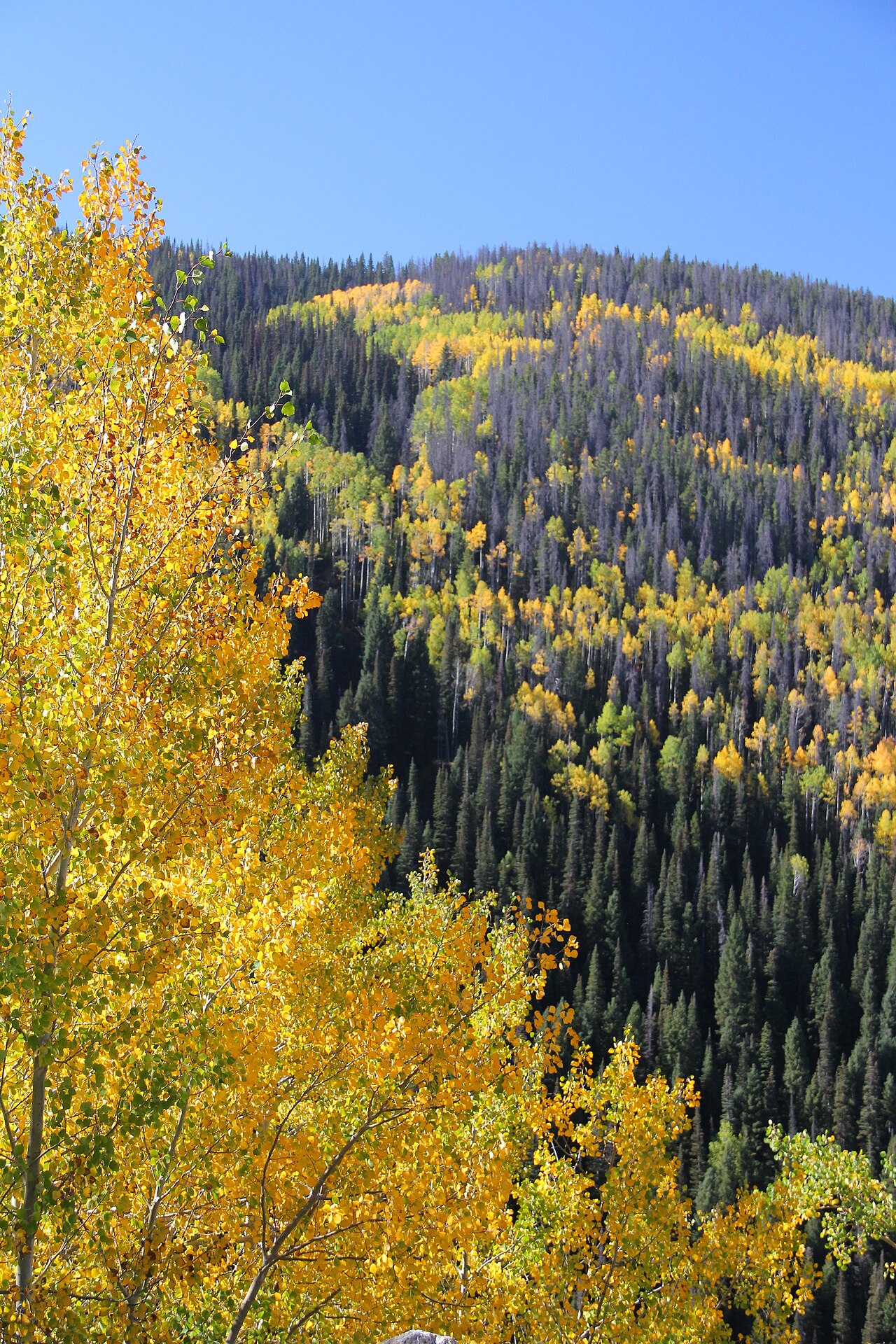
View from Rabbit Ears Pass on US-40 near Steamboat Springs, Colorado, during fall (photographed Sept 25, 2014).
View from Rabbit Ears Pass on US-40 near Steamboat Springs, Colorado, during fall (photographed Sept 25, 2014).Poole.kelli19 (Wikimedia Commons) · CC BY-SA 4.0
00 Live conditions
Open
Temperature
51°F
Road
Clear
Weather
51°F, Clear
Northbound
No restrictions
Southbound
No restrictions

Reported Jun 2, 2026, 11:22 PM MT. Conditions change fast at elevation; confirm with the DOT before you commit.

01 Overview

US Highway 40 climbs over Rabbit Ears Pass between Steamboat Springs on the west and Kremmling on the east. The pass straddles the Continental Divide on the Park Range, and it links the Yampa River basin with North Park and the North Platte drainage. The main east summit sits at 9,426 feet. A lower west summit runs around 9,400 feet, and the road rolls gently near the top before it gives way to the hard descent on the Steamboat side.

The grades are why trucks pay attention here. Westbound toward Steamboat Springs, the road drops roughly 3,000 feet in about 7 miles through a run of sharp curves. CrashForensics measured a vertical descent of 2,467 feet over about 7.5 miles at a reported 7 percent grade. Eastbound is the easier of the two. It loses about 1,197 feet over roughly 5.5 miles. Wikipedia ranks Rabbit Ears the 28th steepest pass in Colorado and notes a single runaway truck ramp on the western descent. That ramp sits on US-40 around mile marker 142 just south of Steamboat Springs. The Colorado Sun reported it was used 10 times in a five-year window, the third-most-used runaway ramp in a state that has 13 of them.

Winter is the other half of the job. The pass takes over 300 inches of snow a year and runs through avalanche terrain on the Park Range, so conditions change fast. CDOT's traction and chain control segment covers US-40 from mile marker 136 south of Steamboat Springs to mile marker 154 near Dumont Lake Campground. The road is maintained year-round and is not seasonally closed. Storms, drifting, avalanche control work, and crashes still shut it temporarily and without much warning. Check COtrip.org or the CDOT app before you commit to the climb.

  • Main east summit 9,426 ft on US-40, with a lower west summit around 9,400 ft (Wikipedia)
  • Westbound drops roughly 3,000 ft over about 7 miles; CrashForensics measured 2,467 ft over 7.5 mi at a reported 7 percent grade (Wikipedia; CrashForensics)
  • Eastbound is milder, about 1,197 ft over roughly 5.5 mi (CrashForensics)
  • Ranked the 28th steepest pass in Colorado, with one runaway truck ramp on the western descent (Wikipedia)
  • Runaway ramp at about mile marker 142 was used 10 times in five years, third-most of Colorado's 13 ramps (Colorado Sun, Dec 3 2023)
  • Chain and traction control segment runs US-40 from MM 136 to MM 154 near Dumont Lake Campground (Steamboat Pilot & Today; CDOT)
  • Over 300 inches of snow a year in a designated Park Range avalanche corridor (Steamboat Pilot 'Killer Curves'; NWS/CAIC)
02 Chain controls & closures

Colorado traction and chain law runs September 1 through May 31. The active segment is US-40 MM 136 to MM 154. This is a year-round route, not seasonally closed, but it shuts temporarily for storms, drifting and whiteouts, avalanche control, and crashes. A March blizzard once closed it 5 or more hours, and a methanol tanker rollover closed it about 6 hours. Check status on COtrip.org and @ColoradoDOT.

03 Notable hazards
Hazard

Steep, curvy westbound descent into Steamboat Springs

Westbound drops about 3,000 ft over roughly 7 miles through many sharp curves. CrashForensics measured 2,467 ft over about 7.5 miles at a reported 7 percent grade. A single runaway truck ramp around mile marker 142 catches rigs with overheated brakes. It was used 10 times in five years, the third-most in Colorado. Gear down before the curves start, not after the brakes are hot (Wikipedia; CrashForensics; Colorado Sun, Dec 3 2023).

Hazard

Black ice on clear days

Ice forms here even when there is no active storm. A fatal wreck happened on a clear day on a curve coated by a roughly 100-foot patch of black ice, the result of snowmelt refreezing. A dry sky over the pass does not mean dry pavement on the shaded curves (Steamboat Pilot & Today, 'Killer Curves').

Hazard

Excessive speed for the grade

CSP and CDOT pinned the high crash rate largely on drivers going too fast over the pass. Officials said running 5 to 10 mph slower would prevent many of the wrecks. The curves and grade punish speed that would be fine on flat ground (Steamboat Pilot & Today, 'Killer Curves').

Hazard

Heavy snow, drifting, and whiteouts

The pass gets more than 300 inches of snow a year, and the open terrain near the summit drifts and drops visibility in a hurry. Winter Storm Warnings for Park Range elevations including Rabbit Ears commonly forecast 6 to 20 inches (NWS Grand Junction/Boulder; Steamboat Pilot & Today).

Hazard

Avalanche control and truck rollovers blocking US-40

The Park Range around Rabbit Ears is avalanche terrain. The Colorado Avalanche Information Center and NWS issue avalanche watches that reach HIGH (Level 4 of 5) for the range, and CDOT closes the road for control work. Recurring semi and tanker rollovers, including a methanol tanker, have closed the pass for hours and forced evacuations. Multiple fatal semi wrecks have happened here in recent years (NWS forecast.weather.gov; CAIC; CBS Colorado; Steamboat Pilot & Today; CDLLife).

04 History

Early trappers named the pass for the twin "Rabbit Ears" rock formation. The route followed Native American and freight trails into the Yampa Valley and North Park. A dirt auto road was finished by 1915 as the "Moffat Highway" (construction 1911 to 1917, per Wikipedia). With US-40 over Berthoud and Rabbit Ears, the route first stayed open through winter in 1936-37. It was the first transmountain transcontinental highway kept open year-round. A realignment from 1957 to 1960 reworked the first 7.7 miles. That cut the road to 17 gentle curves (max 8.5 degrees) from 70 curves up to 24 degrees, for about $3.97 million. The NTSB issued Highway Accident Report HAR-90/02 on a crash here.

05 FAQ
How steep is the truck descent on Rabbit Ears Pass?
Westbound into Steamboat Springs is the hard side: about 3,000 feet of drop over roughly 7 miles through many sharp curves. CrashForensics measured it at 2,467 feet over about 7.5 miles at a reported 7 percent grade. Eastbound is milder, around 1,197 feet over 5.5 miles. Wikipedia calls Rabbit Ears the 28th steepest pass in Colorado.
Is there a runaway truck ramp on Rabbit Ears Pass?
Yes, one ramp, on the western descent toward Steamboat Springs at about US-40 mile marker 142. The Colorado Sun reported it was used 10 times in five years, the third-most-used of Colorado's 13 runaway ramps. If your brakes are fading on the way down, that ramp is there for a reason.
When does the chain law apply, and which mile markers?
Colorado's traction and chain law season runs September 1 through May 31. On Rabbit Ears the controlled segment is US-40 from mile marker 136 south of Steamboat Springs to mile marker 154 near Dumont Lake Campground. When CDOT raises the commercial chain law on that stretch, all commercial vehicles, plus buses and vans rated for 16 or more passengers, have to chain up.
What must passenger vehicles have during a traction law?
Snow or mud-and-snow tires (M+S or the mountain-snowflake symbol) with at least 3/16-inch tread, or AWD/4WD running those tires, or chains or an approved alternative traction device. Non-compliance is a $100 fine plus a $33 surcharge, and $500 plus $157 if your vehicle causes a closure, per CDOT.
Does Rabbit Ears Pass close in winter?
It is a year-round CDOT route, not seasonally closed, but it closes temporarily and without warning during heavy storms, high-wind drifting and whiteouts, avalanche control, and crashes. A March blizzard once shut it for more than 5 hours, and a rolled methanol tanker closed it about 6 hours and forced evacuations. Check COtrip.org or @ColoradoDOT before you go.
Why is Rabbit Ears Pass considered dangerous?
It comes down to a steep curvy grade, more than 300 inches of snow a year, black ice that forms even on clear days from snowmelt refreezing, and drivers carrying too much speed. The local crash record is blunt: 1996 saw 75 crashes with 2 fatal, 1998 saw 88 crashes with a 10-mile summit stretch logging 46 of them and 2 fatal, and four people died on the pass in 1999.
06 Related routes

Rabbit Ears Pass on the live map

See conditions, incidents, and weather around Rabbit Ears Pass in real time.

Open Live Map