← All passes
Mountain pass No. 72 No live data

Continental Divide

I-40 crosses the North American Continental Divide at Campbell Pass, a broad, low saddle in McKinley County in western New Mexico. This is not a peak. The road tops out at a wide east-west valley, which is the whole reason the railroad chose this line in the 1880s and why Route 6

7,275Elevation (ft)
2,217Metres
I-40Route
NMState
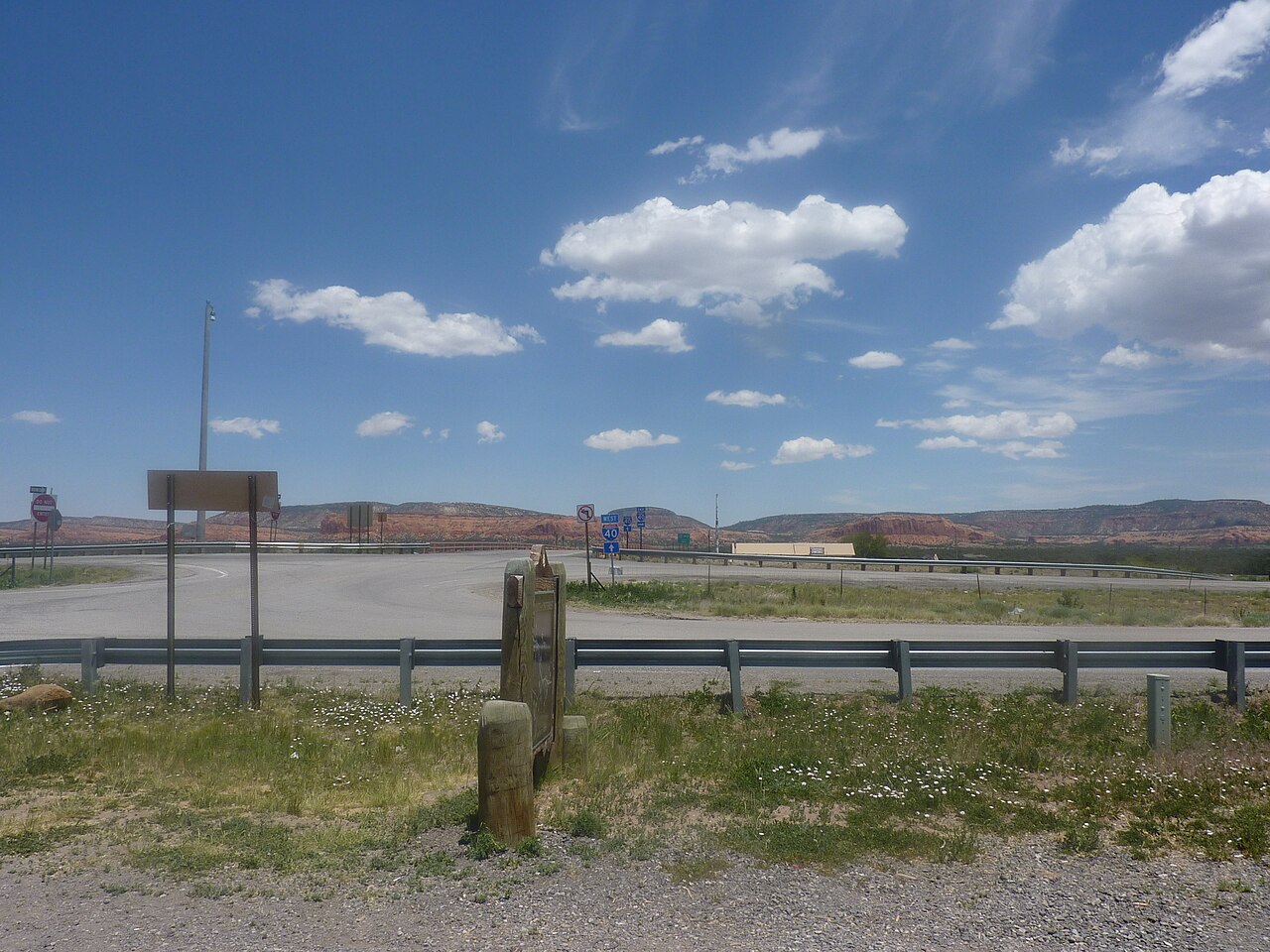
A scenic high-desert view at the Continental Divide near I-40 in New Mexico, looking out over grassland and red-rock mesas from the historic Old Route 66 marker.
A scenic high-desert view at the Continental Divide near I-40 in New Mexico, looking out over grassland and red-rock mesas from the historic Old Route 66 marker.Chris English / Wikimedia Commons · CC BY-SA
00 Live conditions
No live data
No live condition feed for this pass right now. Check the state DOT or 511 before you climb.
01 Overview

I-40 crosses the North American Continental Divide at Campbell Pass, a broad, low saddle in McKinley County in western New Mexico. This is not a peak. The road tops out at a wide east-west valley, which is the whole reason the railroad chose this line in the 1880s and why Route 66 and then I-40 followed it. The headline elevation is 7,275 ft (Wikipedia, Interstate 40 in New Mexico), and the roadside historic marker reads 7,245 ft. Mount Taylor, an 11,305-ft stratovolcano, sits to the east, but the highway itself never climbs anything like that.

The crossing falls between Gallup, about 25 miles to the west, and Grants and Thoreau to the east. Right at the divide sits the unincorporated community of Continental Divide (ZIP 87312), with a 2020 census population of 187 (Wikipedia, Continental Divide, New Mexico). For a trucker this is the high point of the I-40 run across western New Mexico. The NM segment enters from Texas near 4,500 ft and climbs past 7,000 ft near the divide (RMS Truck Insurance I-40 corridor guide), which the same guide sums up plainly: at that altitude your engine makes less power, and you are dealing with mountain weather, not desert weather.

One thing to keep straight. The Continental Divide climb is long and gradual, not a steep grade. The steep, sustained pull on I-40 in New Mexico is Tijeras Canyon east of Albuquerque, roughly mile 167 to 177, and that is where the brake-fade problems cluster. That is a separate place about 150 miles east of the divide. Do not run your pre-trip plan for one as if it were the other.

  • Campbell Pass is a broad valley crossing of the Continental Divide in McKinley County, western New Mexico, not a mountain summit (Wikipedia, Interstate 40 in New Mexico)
  • Headline elevation 7,275 ft; the roadside historic marker reads 7,245 ft (Wikipedia, Interstate 40 in New Mexico; theroute-66.com)
  • Mount Taylor, an 11,305-ft stratovolcano, rises to the east, but I-40 itself stays in the valley (Wikipedia, Interstate 40 in New Mexico)
  • The crossing sits between Gallup, about 25 miles west, and Grants and Thoreau to the east
  • The community of Continental Divide (ZIP 87312) had a 2020 census population of 187 (Wikipedia, Continental Divide, New Mexico)
  • New Mexico has no mandatory chain law; statute 66-3-847 permits chains and studded tires but does not require them (NM Stat. 66-3-847)
  • The railroad through Campbell Pass was built for a very moderate grade, about 21 feet per mile, or 0.4%, and I-40 follows the same corridor (theroute-66.com)
02 Chain controls & closures

There is no chain-control season here, because New Mexico does not run one. The state has no mandatory chain law and no posted chain levels like Colorado or California. Statute 66-3-847 permits chains of reasonable proportions and studded snow tires when you need them for traction on snow or ice, but it does not order anyone to chain up (NM Stat. 66-3-847). There is also no DOT-designated chain-up area or brake-check station at the Continental Divide. So the practical rule is simple: when a winter storm makes the road unsafe, NMDOT does not call for chains, it closes the road. Closures are case-by-case decisions by NMDOT and law enforcement, with no fixed dates and no published snow-depth or wind trigger. They get pushed to the signs and to NMRoads / NM 511. Check that before you run it.

03 Notable hazards
Hazard

High wind and crosswind

The Gallup to Grants corridor regularly gets strong southwest-to-west winds. NWS Albuquerque forecast discussions repeatedly flag gusts and downburst winds along and west of the Continental Divide. High-profile rigs (loaded vans, empties, RVs) are the most exposed (NWS Albuquerque Area Forecast Discussion).

Hazard

Blowing dust and dust storms

Wind on this corridor lifts dust that can drop visibility under a quarter mile and set up multi-vehicle pileups. In a March 18, 2025 event, NWS issued dust storm advisories for less than a quarter-mile visibility and 50 mph winds, with gusts hitting 93 mph at San Augustin Pass; I-40 had a multi-car pileup that day (NWS Albuquerque; Albuquerque Journal, 3/18/2025). That particular pileup was in central New Mexico, not at the divide, but it shows what wind and dust do on this road.

Hazard

Snow and ice at altitude

At 7,000-plus ft this is mountain weather, not desert weather. Snow and ice are real from late fall through early spring, and NMDOT closes lanes proactively when conditions go downhill (RMS Truck Insurance I-40 corridor guide; NMDOT / NM 511).

Hazard

Truck crashes on the climb

Reporting notes that tractor-trailer crashes near Gallup are far too common, tied to grades and congestion, and they often involve multiple vehicles and lane closures (Caruso Law Offices, New Mexico's Most Dangerous Highways).

04 History

Campbell Pass earned its place because of grade, not scenery. Around 1880 to 1881 it was selected as the route for the original main line of the Atlantic and Pacific Railroad, which later became part of the Atchison, Topeka and Santa Fe. Crews chose it for a very moderate grade, about 21 feet per mile, or 0.4%, and built a station near the summit called Gonzales (Wikipedia, Campbell Pass; theroute-66.com). The settlement at the crossing changed names more than once: Continental Divide in 1884, then Summit in 1895, then Gonzales from 1910 to 1936, before it went back to Continental Divide (theroute-66.com).

The highway story runs on the same line. The corridor was designated NM State Highway 6 in 1914, and an 8.6-mile stretch was finished as a divided four-lane road in 1951 (Legends of America). U.S. Route 66 went through Campbell Pass in 1926, and I-40 is its successor along the same corridor (Wikipedia, Campbell Pass). Railroad, Route 66, and Interstate all picked the same low saddle for the same reason.

05 FAQ
How high is the Continental Divide on I-40?
The sign and pass read 7,275 ft (Wikipedia, Interstate 40 in New Mexico), and the roadside historic marker reads 7,245 ft. Either way, it is the high point of the I-40 climb across western New Mexico.
Is it a steep grade for trucks?
No. It is a long, gradual climb through a broad valley pass. The railroad and highway route was picked for a moderate grade, about 0.4% on the rail line. The steep pull on I-40 in New Mexico, the one with the brake-fade problems, is Tijeras Canyon east of Albuquerque, not the divide (theroute-66.com; RMS Truck Insurance).
Do I need chains over the Continental Divide?
New Mexico has no mandatory chain law. Statute 66-3-847 permits chains of reasonable proportions and studded tires when you need traction, but it does not require them. And when it gets bad enough that you would want chains, NMDOT closes the road instead (NM Stat. 66-3-847).
Does I-40 close here in winter?
Yes, case by case in storms, with no fixed dates or trigger numbers. In December 2022 NMDOT closed eastbound I-40 between mile marker 22 at Gallup and mile marker 53 at Thoreau, with the backup reaching the divide, and both I-40 and I-25 closed again in a November 2024 storm. Check NMRoads / NM 511 before you go (KOB-TV; NMDOT NM 511).
What is the biggest day-to-day hazard?
Wind and blowing dust. NWS Albuquerque routinely flags strong gusts west of the Continental Divide, and dust can cut visibility under a quarter mile and cause pileups. High-profile vehicles take the worst of it (NWS Albuquerque; Albuquerque Journal).
Where do I check conditions before I run it?
NMRoads / NM 511 (nmroads.com) is NMDOT's official real-time road and closure system. For wind, dust, and snow, pull up NWS Albuquerque (weather.gov/abq).
06 Related routes

Continental Divide on the live map

See conditions, incidents, and weather around Continental Divide in real time.

Open Live Map