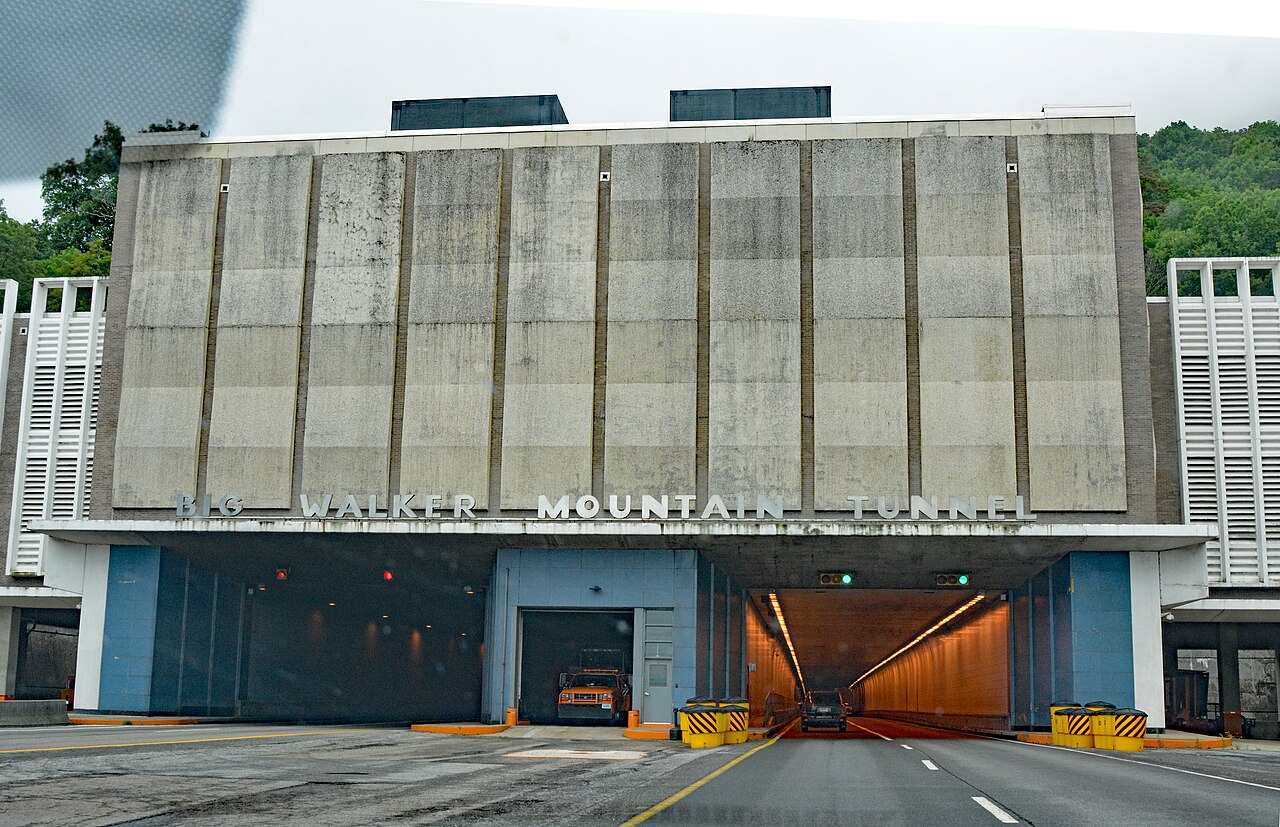
On I-77 in southwest Virginia, "Big Walker Mountain" is the mountain that the road bores straight through. I-77 does not climb over the open summit here. It runs in twin tunnels under Big Walker Mountain in Bland County, between Wytheville to the south and Bland and Bastian to the north, roughly mile markers 47 to 49. Each bore is 4,229 feet long, about 0.80 mile, and the grade through and around the tunnel is a moderate 3.5 percent that slopes up to the north. Northbound trucks climb it. Southbound trucks descend. That is far gentler than most drivers expect from a mountain crossing, because there is no long open-summit descent at all.
Here is the part that trips people up. The steep, deadly I-77 truck grade in Virginia is a different mountain about 45 miles south, near the North Carolina line: Fancy Gap Mountain, roughly mile markers 0 to 8. That grade drops more than 1,500 feet in about 6.2 miles and is one of the steepest on the East Coast. Drivers conflate the two all the time. This page keeps them separate, because both sit on the same corridor and both matter to anyone running freight up or down I-77.
What makes Big Walker worth your attention is not the grade. It is the choke point. The tunnel carries two lanes each way with no shoulder and no escape lane inside the bore. One disabled truck or a crash at a portal can back I-77 up for miles. Add winter ice at roughly 3,600 feet of elevation, the occasional nightly single-tube maintenance closure, and the in-tunnel fire risk that any long enclosed crossing carries, and you have a spot that rewards a driver who knows what is coming.
- Twin-bore tunnel carrying I-77 under Big Walker Mountain in Bland County, Virginia, between Wytheville and Bland/Bastian, about mile markers 47 to 49 (VDOT)
- Each bore is 4,229 feet long, about 0.80 mile (roadstothefuture.com / ASCE Virginia; AARoads)
- Grade is 3.5 percent, sloping up to the north, so northbound climbs and southbound descends (roadstothefuture.com / ASCE Virginia)
- Mountain crest above the tunnel is 3,650 feet, with up to about 800 feet of rock overburden above the pavement (roadstothefuture.com / ASCE Virginia; bdtonline)
- Roadway is 26 feet wide per two-lane bore; vertical clearance is cited at about 15.5 to 16.5 feet, so obey the posted tunnel signs (roadstothefuture.com / ASCE; bdtonline)
- About 11 million vehicles pass through the tunnel each year (bdtonline; VDOT)
- Opened to traffic June 29, 1972, after a tunnel contract of about $22.6 million (FHWA; Wikipedia; bdtonline)