← All passes
Mountain pass No. 40 Chains

Stevens Pass

US-2 crosses the Cascade Range at Stevens Pass, topping out at 4,061 feet on the line between King and Chelan counties in Washington. The pass links the Puget Sound side, running west through Everett, Monroe, and Skykomish, with Leavenworth and Wenatchee on the east slope. When S

4,061Elevation (ft)
1,238Metres
US-2Route
WAState
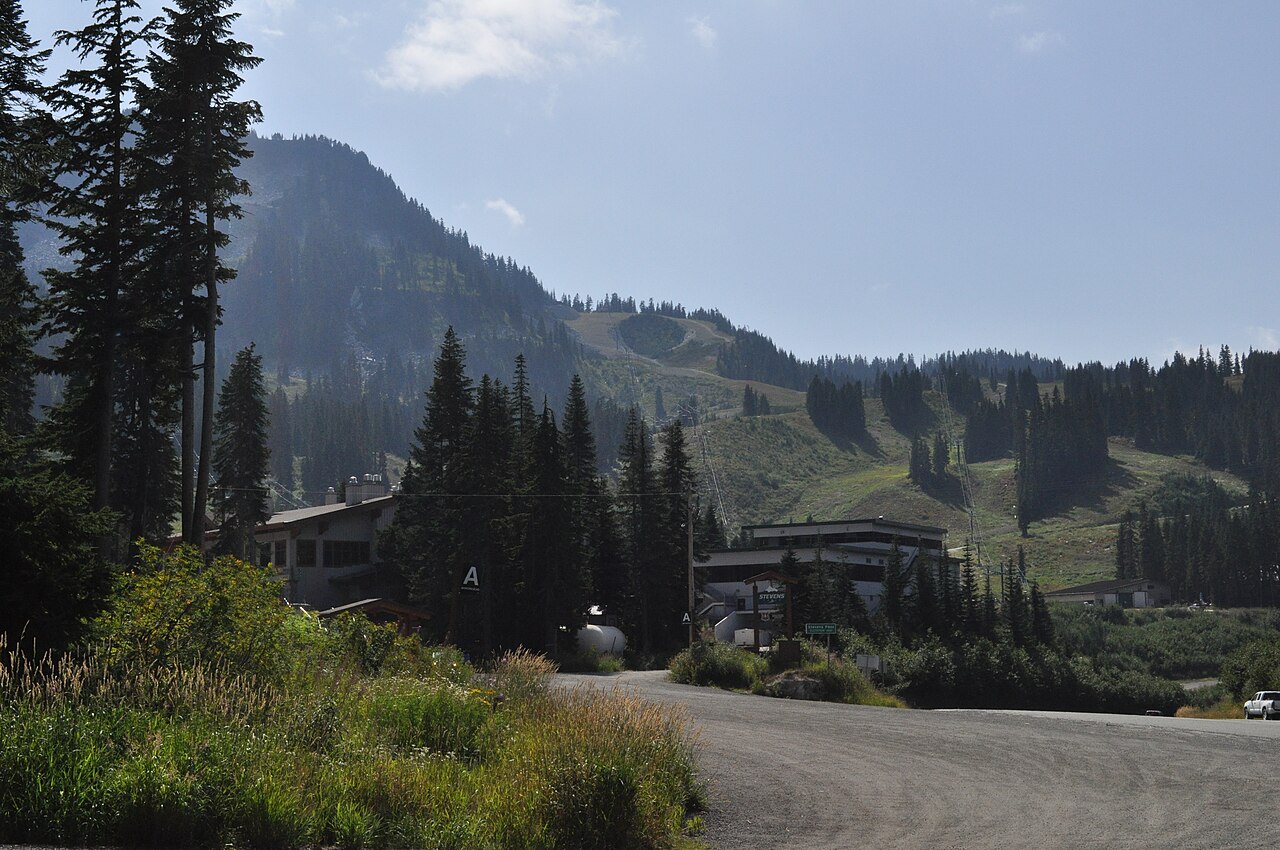
Stevens Pass summit and ski area on the US-2 Cascade crossing, Washington
Stevens Pass summit and ski area on the US-2 Cascade crossing, WashingtonJoe Mabel / Wikimedia Commons · CC BY-SA 3.0
00 Live conditions
Chains
Road
Reports have ended for this season. Traditionally weather and road conditions are reported on this page from November 1 to April 1. Should adverse weather occur that will impact travel, updates will be provided as information is available.
Northbound
No restrictions
Southbound
No restrictions

Reported May 18, 2026, 12:45 AM MT. Conditions change fast at elevation; confirm with the DOT before you commit.

01 Overview

US-2 crosses the Cascade Range at Stevens Pass, topping out at 4,061 feet on the line between King and Chelan counties in Washington. The pass links the Puget Sound side, running west through Everett, Monroe, and Skykomish, with Leavenworth and Wenatchee on the east slope. When Snoqualmie Pass and I-90 to the south are in trouble, Stevens is the parallel Cascade crossing freight falls back on.

Plan for the westbound climb. It runs about 9.8 miles to the summit with roughly 2,729 feet of gain at a 5.3 percent average grade. The steepest sustained mile sits around 6.3 percent (PJAMM Cycling, Stevens Pass West). That means a long downgrade off the west side for loaded rigs coming east to west, so watch your brakes and gear down before the grade gets away from you. WSDOT does not list a permanent length or weight ban specific to Stevens Pass, so standard commercial vehicles use it. The rules that bite are seasonal: chain-carry and chain-up requirements for anything over 10,000 pounds.

Winter is the hard part. Stevens is one of the snowiest highway crossings in the country, averaging about 471.8 inches a season on the long-term record, and WSDOT cites more than 450 inches for both Stevens and Snoqualmie. Twelve active avalanche paths cross US-2 at the pass, and WSDOT controls every one of them through the season. The path that runs most often carries the nickname Old Faithful. Add heavy snow, chain controls, and the occasional spun-out truck blocking the climb, and you get the closures the pass is known for.

  • Summit 4,061 ft (1,238 m) on US-2, the Cascade crossing on the King and Chelan county line (Wikipedia; WSDOT)
  • Westbound climb is about 9.8 miles with roughly 2,729 ft of gain at a 5.3 percent average grade; steepest mile near 6.3 percent (PJAMM Cycling)
  • Averages about 471.8 inches of snow a season on the long-term record; WSDOT cites more than 450 inches (Wikipedia/NWS-derived; WSDOT)
  • Twelve active avalanche paths cross US-2 at the pass; the one that runs most often is nicknamed Old Faithful (WSDOT Avalanche Control)
  • Vehicles over 10,000 lb must carry chains Nov 1 to Apr 1 on SR-2/US-2 in any weather, plus two spare chains (WSDOT)
  • The BNSF Cascade Tunnel runs 7.8 miles about 1,180 ft below the summit; it opened in 1929 and is the longest railroad tunnel in the US (Wikipedia)
  • No permanent length or weight truck ban specific to Stevens Pass; standard commercial vehicles use it (WSDOT)
02 Chain controls & closures

Chains required Nov 1 to Apr 1 for over-10,000-lb vehicles. No fixed closure date. The pass closes as needed for avalanche control and weather.

03 Notable hazards
Hazard

Avalanches across twelve slide paths

US-2 crosses twelve active avalanche paths at the pass. WSDOT's Stevens Pass crew fires a 105 mm howitzer and sets explosives delivered by cable trams to release slides before they reach the road. The path that runs most often is nicknamed Old Faithful. Control work forces temporary closures, usually held between midnight and 6 a.m. (WSDOT Avalanche Control).

Hazard

Heavy snow and chain conditions

The pass averages roughly 471.8 inches a season on the long-term record, among the deepest of any US highway crossing. Expect frequent chains-required and traction-tires-required postings. Vehicles over 10,000 lb have to carry chains Nov 1 to Apr 1 and chain up when posted, even with 4WD or AWD (Wikipedia climate record; WSDOT chain rules).

Hazard

Steep sustained westbound grade

The westbound approach climbs about 9.8 miles to the 4,061 ft summit at a 5.3 percent average grade, with the steepest mile near 6.3 percent. That leaves a long downgrade for loaded trucks descending the west side. Watch your brakes and gear down before the grade, not after (PJAMM Cycling; Wikipedia).

Hazard

Washouts, mudslides, and rockfall

The steep canyon terrain along US-2 sheds rock and is prone to washouts and slope failures. In 2025 WSDOT ran emergency repairs over a 12-mile section between mileposts 58 and 70 over the summit after multiple washouts and mudslides, with more work in Tumwater Canyon between MP 90 and 97 (WSDOT news, 2025).

Hazard

Summit congestion and blocking vehicles

Ski-season traffic and illegally parked or stranded vehicles at the summit have forced full closures of US-2. Spun-out trucks running without chains block the climb too (KING 5 / WSDOT reports).

04 History

The 1910 Wellington avalanche killed 96 people and led to the Cascade Tunnel. The pass carries US-2 over the Cascades at 4,061 ft.

05 FAQ
How high is Stevens Pass and how steep is the climb?
The summit is 4,061 feet (1,238 m). The westbound climb runs about 9.8 miles with roughly 2,729 feet of gain at a 5.3 percent average grade, and the steepest sustained mile sits around 6.3 percent. The catch for trucks is the long downgrade off the west side, so gear down early.
Do trucks need chains over Stevens Pass, and when?
Yes. Any vehicle over 10,000 pounds GVW has to carry chains from November 1 to April 1 on SR-2/US-2, in any weather, plus two spare chains. When CHAINS REQUIRED is posted you have to chain up, including 4WD and AWD. At least one cross-chain must touch the road. Skipping a required chain-up runs about $500.
Why does US-2 at Stevens Pass close so often in winter?
Mostly for avalanche control. WSDOT works twelve slide paths and holds traffic at the summit (about MP 64) and at Scenic (about MP 56), usually between midnight and 6 a.m. Closures also hit for natural avalanche danger, crashes, and stranded or blocking vehicles at the summit.
Is there a truck weight or length restriction on Stevens Pass?
WSDOT does not list a permanent length or weight ban specific to Stevens Pass, and standard commercial vehicles use it. The restrictions that apply are the seasonal chain-carry and chain-up rules, plus possible oversize-load limits when winter conditions are posted.
What is the deadliest thing that ever happened at Stevens Pass?
The Wellington avalanche on March 1, 1910. An avalanche off Windy Mountain swept two stranded Great Northern trains into the Tye River canyon and killed 96 people, with 23 survivors. It is still the deadliest avalanche in US history.
Is Stevens Pass a good detour when I-90 over Snoqualmie is closed?
It is the parallel Cascade crossing to the north, connecting Everett to Leavenworth and Wenatchee. But it runs the same chain rules, twelve avalanche paths, more than 450 inches of snow a year, and its own control closures. Check the WSDOT pass reports for both crossings before you commit.
06 Related routes

Stevens Pass on the live map

See conditions, incidents, and weather around Stevens Pass in real time.

Open Live Map