← All passes
Mountain pass No. 13 No live data

Cumberland Gap

US-25E crosses Cumberland Gap through a tunnel, not over a summit. The route runs under Cumberland Mountain in a twin-tube, four-lane tunnel at the point where Kentucky, Tennessee, and Virginia nearly meet. The TN-KY state line sits about at the tunnel's midpoint. Each bore is 4,

1,304Elevation (ft)
397Metres
US-25ERoute
TN/KY/VAState
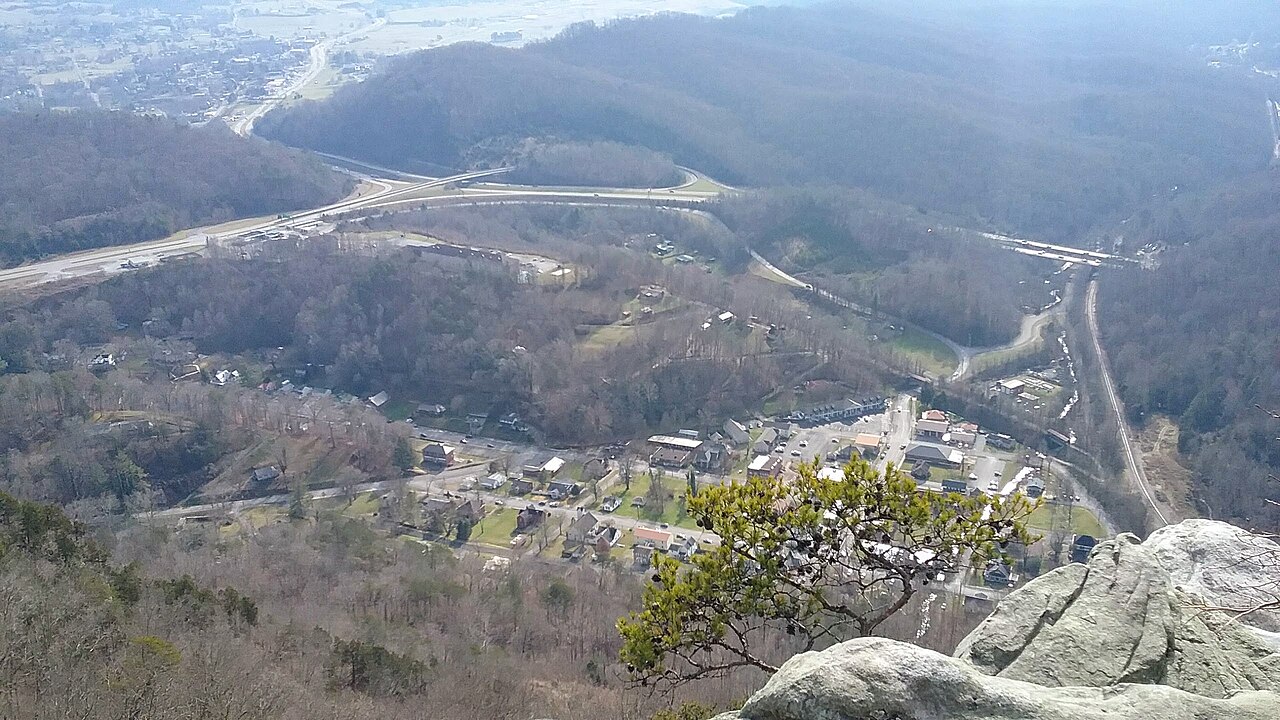
The view from Pinnacle Overlook down onto Cumberland Gap, with the town of Cumberland Gap, Tennessee, the US-25E/US-58 junction, and the south entrance of the Cumberland Gap Tunnel.
The view from Pinnacle Overlook down onto Cumberland Gap, with the town of Cumberland Gap, Tennessee, the US-25E/US-58 junction, and the south entrance of the Cumberland Gap Tunnel.Bneu2013 / Wikimedia Commons · CC BY-SA
00 Live conditions
No live data
No live condition feed for this pass right now. Check the state DOT or 511 before you climb.
01 Overview

US-25E crosses Cumberland Gap through a tunnel, not over a summit. The route runs under Cumberland Mountain in a twin-tube, four-lane tunnel at the point where Kentucky, Tennessee, and Virginia nearly meet. The TN-KY state line sits about at the tunnel's midpoint. Each bore is 4,600 ft long, roughly 0.9 mile, with two lanes per tube (Wikipedia, cgtunnel.com FAQ). Inside, the speed limit is 45 mph and the posted clearance is 16 ft 6 in (Wikipedia, cgtunnel.com FAQ).

For a driver running freight between I-81 and I-75, this is the mountain connection. US-25E covers about 112.8 miles from Newport, TN to North Corbin, KY, tying I-81 at Morristown to I-75 near Corbin and threading through Tazewell, Harrogate, Middlesboro, and Pineville along the way (Wikipedia, U.S. Route 25E). It carries roughly 32,000 vehicles a day (Wikipedia). It has been on the FHWA National Network since 1982 and was named High-Priority Corridor 12 in 1991, so it is a designated federal truck route (Wikipedia, U.S. Route 25E).

The hazards here are tunnel hazards, not pass hazards. There is no chain control, no runaway-truck ramp, and no winter summit to climb. What you do hit is a clearance limit, hazmat escort rules, brief traffic holds at the portals, and the chance of ice where heavy mountain drainage meets cold approaches. The tunnel runs 24/7, staffed by certified operators, with cameras, ventilation fans, and gas monitoring throughout (cgtunnel.com).

  • Twin-tube, four-lane tunnel carries US-25E under Cumberland Gap National Historical Park where KY, TN, and VA meet (Wikipedia)
  • Each bore is 4,600 ft long, about 0.9 mile, 32 ft wide and 16.5 ft high, two lanes per tube (Wikipedia, cgtunnel.com FAQ)
  • Posted clearance is 16 ft 6 in; over-height sensors on the approaches flag too-tall vehicles (cgtunnel.com FAQ)
  • Speed limit inside the tunnel is 45 mph (Wikipedia)
  • Traffic runs about 32,000 vehicles per day (Wikipedia)
  • US-25E runs about 112.8 miles from Newport, TN to North Corbin, KY, linking I-81 to I-75 (Wikipedia, U.S. Route 25E)
  • Owned by the National Park Service; operated 24/7 by KYTC and TDOT through the Cumberland Gap Tunnel Authority in Middlesboro, KY (cgtunnel.com, KYTC)
02 Chain controls & closures

There is no chain-control season at Cumberland Gap. US-25E crosses through a ventilated tunnel under the mountain, not over an exposed summit, so the Western-style chain-up program does not apply here. No source from KYTC, TDOT, NPS, the tunnel authority, or Wikipedia documents a chain-up area, a brake-check area, or a chain season for this route. The tunnel runs 24/7 with no published seasonal or winter closure. When it does close, the cause is an incident or scheduled maintenance: a lane or bore shut for work, or a short stop while certified operators escort a hazmat load. KYTC posts scheduled lane-closure notices for the tunnel when maintenance is planned. There is no published numeric weather threshold that triggers a full closure; CGTA, KYTC, and TDOT handle weather case by case.

03 Notable hazards
Hazard

Over-height vehicles

Clearance is 16 ft 6 in. Sensors on the approaches flag vehicles that exceed it before they reach the portal. A truck taller than the limit is the realistic modern hazard here, so know your height before you commit to the lane (cgtunnel.com FAQ).

Hazard

Hazmat escort stops and sudden traffic holds

Traffic is periodically stopped to escort hazmat or oversized commercial loads through one bore at a time. The hold is usually 5 minutes or less, but expect an unexpected stop at the portals (NPS Traffic & Travel Tips, cgtunnel.com FAQ).

Hazard

Water and ice at the portals

The mountain releases roughly 450 gallons of water per minute, handled by tunnel drainage and a PVC lining. Standing water and cold portals make icing an inherent winter concern at the approaches (cgtunnel.com About).

Hazard

Fire or smoke in a confined bore

The tunnel is monitored for smoke, heat, and carbon monoxide through a SCADA system, with ventilation fans, cross-passages, extinguishers, and emergency phones. A vehicle fire forces a bore closure and reroutes traffic through escort (cgtunnel.com, Wikipedia).

04 History

In 1916, Kentucky, Tennessee, and Virginia built the original two-lane US-25E across the 2.3-mile saddle of Cumberland Mountain. The crossing earned the name "Massacre Mountain" for its crash record. A 1985 U.S. Department of the Interior report counted 239 collisions and 19 deaths on the Kentucky side between 1967 and 1978, with 42 accidents and one death logged on the Virginia stretch from 1953 to 1977 (Appalachian Historian, citing the 1985 DOI report). The old road's accident rate ran about six times that of comparable federal highways while carrying roughly twice its design traffic (cgtunnel.com About, Appalachian Historian).

Boring began on June 21, 1991, and the two headings met inside the mountain on July 9, 1992 (Wikipedia, Appalachian Historian). The tunnel opened to traffic on October 18, 1996, after a ribbon-cutting by officials from all three states. The full project, twin bores plus about 5 miles of four-lane approaches and bridges, cost about $280 million (Wikipedia, Appalachian Historian). The old over-mountain road was then closed and the land restored to the national park. The old crossing had averaged roughly five deaths a year; in the tunnel era, only two traffic-related deaths have been tied to the tunnel, a figure reported by the Appalachian Historian as a secondary source.

05 FAQ
How tall can my truck be through the Cumberland Gap Tunnel?
Posted clearance is 16 ft 6 in. Over-height sensors on the approaches catch vehicles that exceed it before the portal, so check your height before you reach the tunnel (cgtunnel.com FAQ).
Can I take hazmat through the tunnel?
Classes 2 through 8 are allowed, but you will be inspected and escorted through one bore at a time by certified operators. Class 1 explosives are banned. If you are in an RV, shut off the propane before you enter (cgtunnel.com FAQ).
How long will the escort stop hold me up?
Usually 5 minutes or less. Traffic gets briefly stopped while certain commercial vehicles are escorted, then it moves again (NPS Traffic & Travel Tips).
Does US-25E close at Cumberland Gap in winter, and do I need chains?
No seasonal closure and no chain control. The tunnel runs 24/7. Closures are incident or maintenance driven, not scheduled by season. Watch for ice at the portals, since the mountain drains a lot of water and the approaches get cold (cgtunnel.com, NPS, KYTC bulletins).
Is there a runaway-truck ramp or a steep summit I have to climb?
No. The route goes through a level tunnel under the mountain, not over the old steep summit. The crash-prone over-mountain road was removed in 1996. A DOT grade figure for the modern approaches is not published, so do not count on a posted number (FHWA highway-history, Appalachian Historian, Wikipedia).
Who runs the tunnel and who do I call?
The National Park Service owns it. KYTC and TDOT operate it 24/7 through the Cumberland Gap Tunnel Authority, based in Middlesboro, KY. For the national park, the contact is (606) 248-2817 (cgtunnel.com, KYTC, NPS).
06 Related routes

Cumberland Gap on the live map

See conditions, incidents, and weather around Cumberland Gap in real time.

Open Live Map