← All National Parks
National Park No. WA No nonresident surcharge

Mount Rainier National Park

Mount Rainier is the most heavily glaciated peak in the contiguous United States and the most topographically prominent mountain in the lower 48 — a 14,411-ft active stratovolcano that towers 13,000 ft above its surrounding terrain. The park around it (designated 1899, the fifth-…

I-5Nearest Interstate
1State
4FAQ
2Active Alerts
01 Park overview

Mount Rainier is the most heavily glaciated peak in the contiguous United States and the most topographically prominent mountain in the lower 48 — a 14,411-ft active stratovolcano that towers 13,000 ft above its surrounding terrain. The park around it (designated 1899, the fifth-oldest US national park) protects 236,000 acres of old-growth forest, subalpine meadows, and 25 named glaciers. The signature visitor area is Paradise on the south flank, accessible from I-5 via WA-512, WA-7, and WA-706 to the Nisqually Entrance — the only entrance plowed year-round. Sunrise on the northeast flank is the highest point reached by a paved road in the park (6,400 ft) but its access road closes in winter. A timed-entry reservation system was piloted in 2024 and 2025 and is expected to continue at Paradise and Sunrise during summer 2026.

  • Most heavily glaciated peak in the contiguous US (25 named glaciers, 35 sq mi of ice)
  • Most topographically prominent mountain in the lower 48 (13,000+ ft of relief)
  • Active stratovolcano, last erupted ~1894; monitored continuously by USGS
  • Fifth-oldest US national park (designated 1899)
  • ~1.6 million visitors per year, concentrated at Paradise and Sunrise
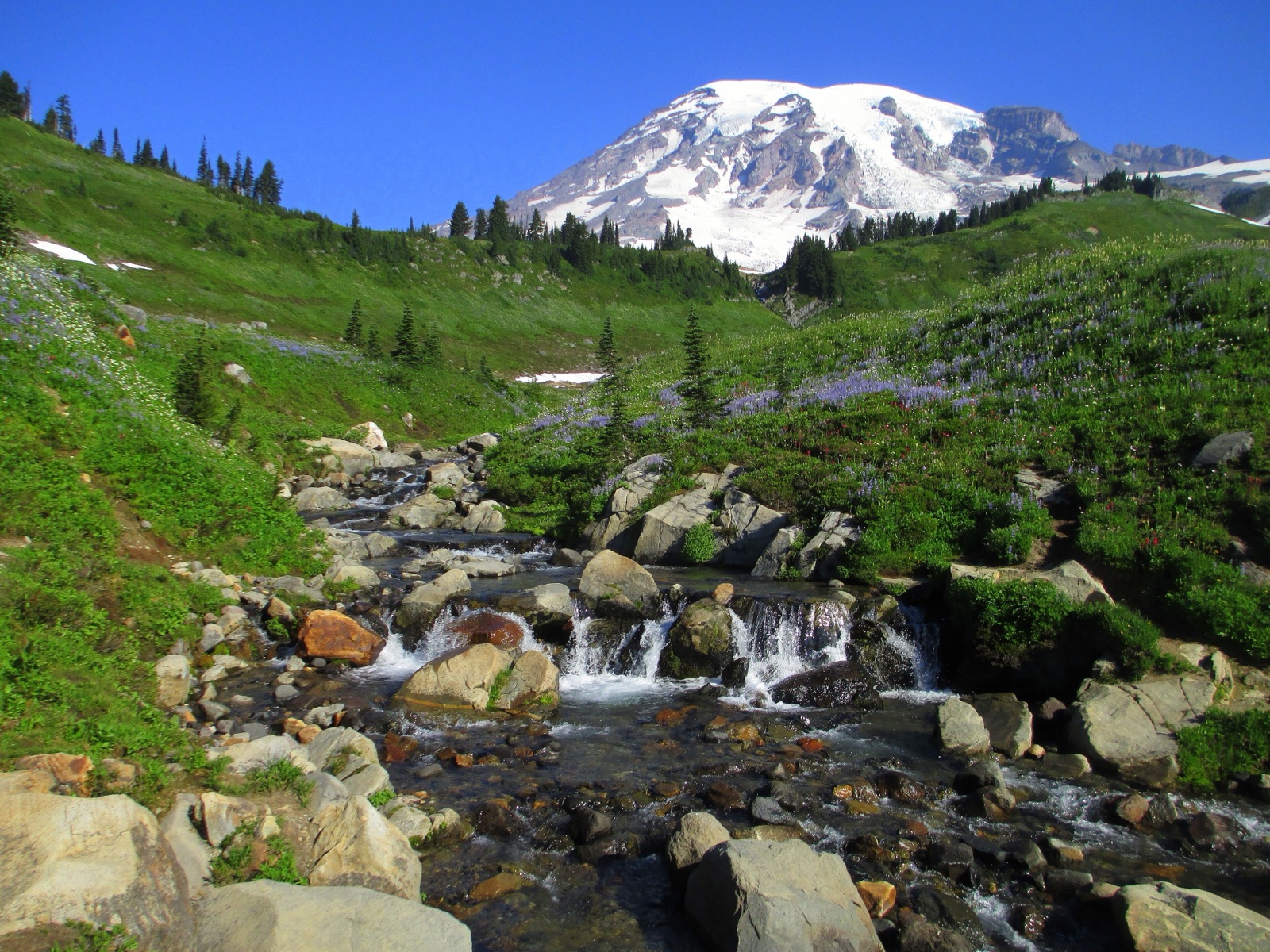
02 Photos
Mount Rainier from above Myrtle Falls, Paradise
Mount Rainier from above Myrtle Falls, Paradise Wikimedia Commons · CC BY-SA
03 Don't miss
  • Paradise visitor area and meadow boardwalks
  • Sunrise overlook (6,400 ft, summer only)
  • Reflection Lakes pullout
  • Grove of the Patriarchs ancient cedars
  • Tipsoo Lake and Chinook Pass (US-410)
04 Getting there & truck/RV access
Route from interstate

From I-5

Exit 127 (WA-512 East / Tacoma)

55 mi southeast via WA-512, WA-7, and WA-706 to the Nisqually Entrance

Big rigs & RVs

Truck access

WA-512, WA-7, and WA-706 to the Nisqually Entrance are paved and accommodate any vehicle size. Inside the park, the road from Nisqually to Paradise is paved with sustained 5-7% grades and tight switchbacks — engine brake heavily on the descent.

Parking: Paradise upper and lower lots fill by 9 AM most summer days; Sunrise fills by 10 AM. Longmire and Ohanapecosh have RV-capable parking. Truck-friendly fuel is at Tacoma and the WA-410 corridor (Enumclaw); none inside the park.

Restrictions: Vehicles over 30 ft are not advised on Stevens Canyon Road (especially the section near Box Canyon). RVs and trailers are prohibited on Mowich Lake Road and Carbon River Road (gravel, narrow).

05 Seasonality & road closures

Best months: Mid-July through mid-September — full road access, wildflower bloom at Paradise, lowest closure risk.

Closures: The Stevens Canyon Road / Sunrise / White River corridor closes from late October through late June. The Nisqually-to-Paradise road stays plowed in winter (chains required Nov–April). Paradise visitor center hours are reduced in winter.

Notes: Reservations may be required for Paradise and Sunrise from late May through early September — verify before traveling. Weather changes fast; whiteout conditions possible above tree line in any month.

06 Entrance fees (2026)
PassPrice
Private vehicle (7-day) $30
Motorcycle (7-day) $25
Individual / walk-in (7-day, age 16+) $15
Park-specific annual pass $55 (Mount Rainier Annual Pass)
America the Beautiful (annual, all NPS sites) $80 U.S. residents · $250 non-residents

2026 nonresident fee — does not apply here

The $100 NPS nonresident surcharge applies at 11 specifically named parks. Mount Rainier National Park is not on that list, so non-U.S. residents pay the same standard entrance fees as U.S. residents.

Fee-free days available for U.S. residents only beginning January 1, 2026.

Note: Timed-entry reservation ($2) may be required at Paradise and Sunrise during peak summer — separate from entrance fee.

Official NPS fee page →

07 Current alerts (2)

Active National Weather Service alerts and FEMA disaster declarations affecting Mount Rainier National Park's state(s). Updated every 15 minutes.

SEVERE THUNDERSTORM WATCH

Severe Thunderstorm Watch issued April 25 at 5:26PM CDT until April 26 at 12:00AM CDT by NWS Tulsa OK

Benton, AR; Carroll, AR; Franklin, AR; Madison, AR; Washington, AR; Adair, OK; Cherokee, OK; Craig, OK; Delaware, OK; Mayes, OK; Nowata, OK; Osage, OK; Ottawa, OK; Pawnee, OK; Rogers, OK; Tulsa, OK; W

SEVERE THUNDERSTORM WATCH

Severe Thunderstorm Watch issued April 25 at 2:48PM CDT until April 25 at 9:00PM CDT by NWS Topeka KS

Clay, KS; Cloud, KS; Dickinson, KS; Ottawa, KS; Republic, KS; Washington, KS

08 FAQ
How do I get to Mount Rainier from I-5?
55 miles southeast of I-5 Exit 127 in Tacoma via WA-512, WA-7, and WA-706 to the Nisqually Entrance. The drive takes about 90 minutes. Tacoma has multiple truck-friendly fuel stops.
Do I need a timed-entry reservation?
In 2024 and 2025, a timed-entry reservation ($2) was required at Paradise and Sunrise from late May through early September. The 2026 system is expected to continue — check NPS.gov/mora before traveling.
Does the $100 nonresident fee apply at Mount Rainier?
No. Mount Rainier is not on the 2026 NPS nonresident-surcharge list. The standard $30 vehicle fee applies to all visitors.
Can I see the mountain in winter?
Yes — the road from the Nisqually Entrance to Paradise stays plowed year-round (chains required November–April). Sunrise and Stevens Canyon close late October through late June.

Mount Rainier National Park on the live map

See real-time weather alerts, wildfires, and road incidents around the park before you head out.

Open Live Map