← All National Parks
National Park No. CO No nonresident surcharge

Great Sand Dunes National Park

Great Sand Dunes contains the tallest sand dunes in North America — Star Dune and Hidden Dune both top 750 ft of relief from the Medano Creek floodplain — set against the Sangre de Cristo Mountains in southern Colorado. The dunes formed when prevailing southwesterly winds funnele…

I-25Nearest Interstate
1State
4FAQ
0Active Alerts
01 Park overview

Great Sand Dunes contains the tallest sand dunes in North America — Star Dune and Hidden Dune both top 750 ft of relief from the Medano Creek floodplain — set against the Sangre de Cristo Mountains in southern Colorado. The dunes formed when prevailing southwesterly winds funneled sand into a natural pocket against the mountains, where it has accumulated for at least 440,000 years. Spring snowmelt creates Medano Creek, a wide, shallow stream that flows along the dunes' east edge from late April through early July with surge waves — a phenomenon found in only a handful of places worldwide. From I-25 the standard access is Exit 52 in Walsenburg, then 75 mi west on US-160 over La Veta Pass to the San Luis Valley, then north on CO-150 to the entrance. The park was redesignated from monument to national park (and preserve) in 2004.

  • Tallest dunes in North America — Star Dune at ~750 ft of relief
  • Medano Creek flows beside the dunes April–July with rare surge-wave phenomenon
  • Park designated 2004 (formerly a national monument since 1932)
  • Dune sand surface temperatures can exceed 150°F on summer afternoons
  • San Luis Valley around the park is one of the largest alpine valleys in the world
02 Photos
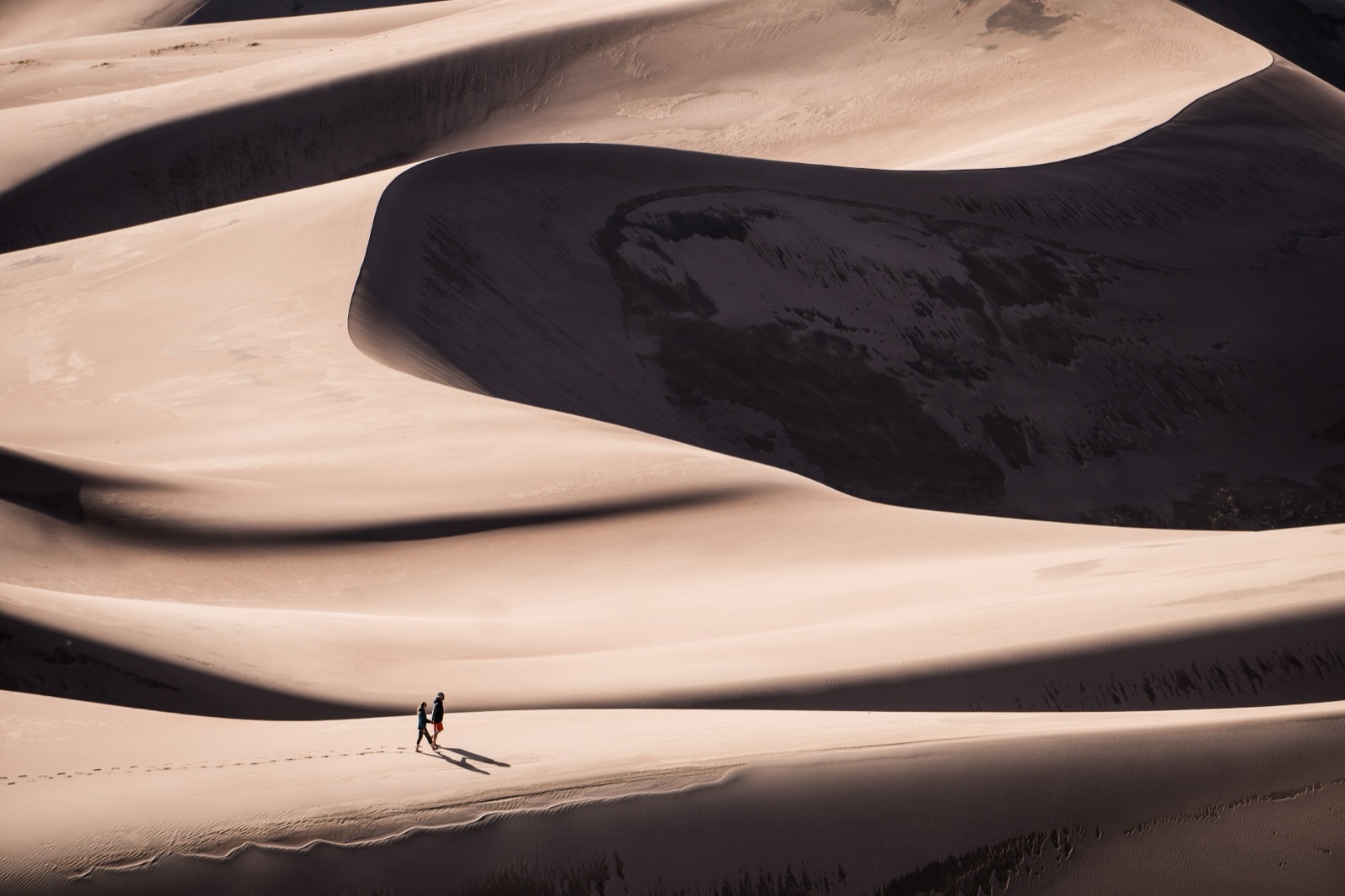
Star Dune and the Sangre de Cristo Mountains, Great Sand Dunes
Star Dune and the Sangre de Cristo Mountains, Great Sand Dunes Wikimedia Commons · CC BY-SA
03 Don't miss
  • Hike to High Dune (650 ft, ~2 hours)
  • Medano Creek splash and surge waves (April–July)
  • Dune sledding and sandboarding (rentals in nearby Mosca)
  • Mosca Pass Trail into the Sangre de Cristos
  • Zapata Falls (BLM land just south of the park)
04 Getting there & truck/RV access
Route from interstate

From I-25

Exit 52 (Walsenburg, CO / US-160 W)

75 mi west on US-160 then north on CO-150 to the visitor center

Big rigs & RVs

Truck access

US-160 over La Veta Pass and CO-150 to the entrance are paved and unrestricted. Inside the park, the Dunes Parking Area road is paved; Medano Pass Primitive Road (the route from the dunes to the Wet Mountain Valley) is high-clearance 4WD-only and prohibited to RVs.

Parking: Visitor center and dunes parking lots are RV-capable. Truck-friendly fuel is at Walsenburg (I-25), Alamosa (US-160 west of the park), and Fort Garland.

Restrictions: Medano Pass Primitive Road: 4WD-only, RVs and trailers prohibited. The dunes themselves have no vehicle access — foot or sled only.

05 Seasonality & road closures

Best months: May through June for Medano Creek and cooler dune surface temps; September–October for clear skies and minimal crowds.

Closures: No seasonal road closures on the main paved network. Medano Pass Primitive Road is closed October through May. Visitor center and main dunes parking stay open year-round.

Notes: Summer dune surface temperatures exceed 150°F by mid-day — wear closed-toe shoes and avoid midday climbs. Lightning is a serious hazard on the dunes during summer afternoons.

06 Entrance fees (2026)
PassPrice
Private vehicle (7-day) $25
Motorcycle (7-day) $20
Individual / walk-in (7-day, age 16+) $15
Park-specific annual pass $45 (Great Sand Dunes Annual Pass)
America the Beautiful (annual, all NPS sites) $80 U.S. residents · $250 non-residents

2026 nonresident fee — does not apply here

The $100 NPS nonresident surcharge applies at 11 specifically named parks. Great Sand Dunes National Park is not on that list, so non-U.S. residents pay the same standard entrance fees as U.S. residents.

Fee-free days available for U.S. residents only beginning January 1, 2026.

Note: Cashless park — credit/debit only at the entrance station.

Official NPS fee page →

07 Current alerts
No active NWS weather alerts or FEMA disaster declarations in Great Sand Dunes National Park's state(s) right now.
08 FAQ
How do I get to Great Sand Dunes from I-25?
75 miles west of I-25 Exit 52 in Walsenburg. Take US-160 west over La Veta Pass into the San Luis Valley, then CO-150 north to the entrance. The route is paved and unrestricted; allow 90 minutes from I-25.
When does Medano Creek run?
Late April through early July, peaking in late May / early June. Flow is heaviest 1-2 weeks after Sangre de Cristo snowmelt peaks. By mid-July the creek bed is typically dry. The surge-wave phenomenon is most visible at peak flow.
Does the $100 nonresident fee apply?
No. Great Sand Dunes is not on the 2026 NPS nonresident-surcharge list. The standard $25 vehicle fee applies to all visitors.
Can I sled or snowboard the dunes?
Yes — sandboards and sleds are rented at shops in Mosca and Alamosa (none inside the park). Bring or buy wax to glide on dry sand. The dunes are not skiable on standard snow gear (no snow grip).

Great Sand Dunes National Park on the live map

See real-time weather alerts, wildfires, and road incidents around the park before you head out.

Open Live Map