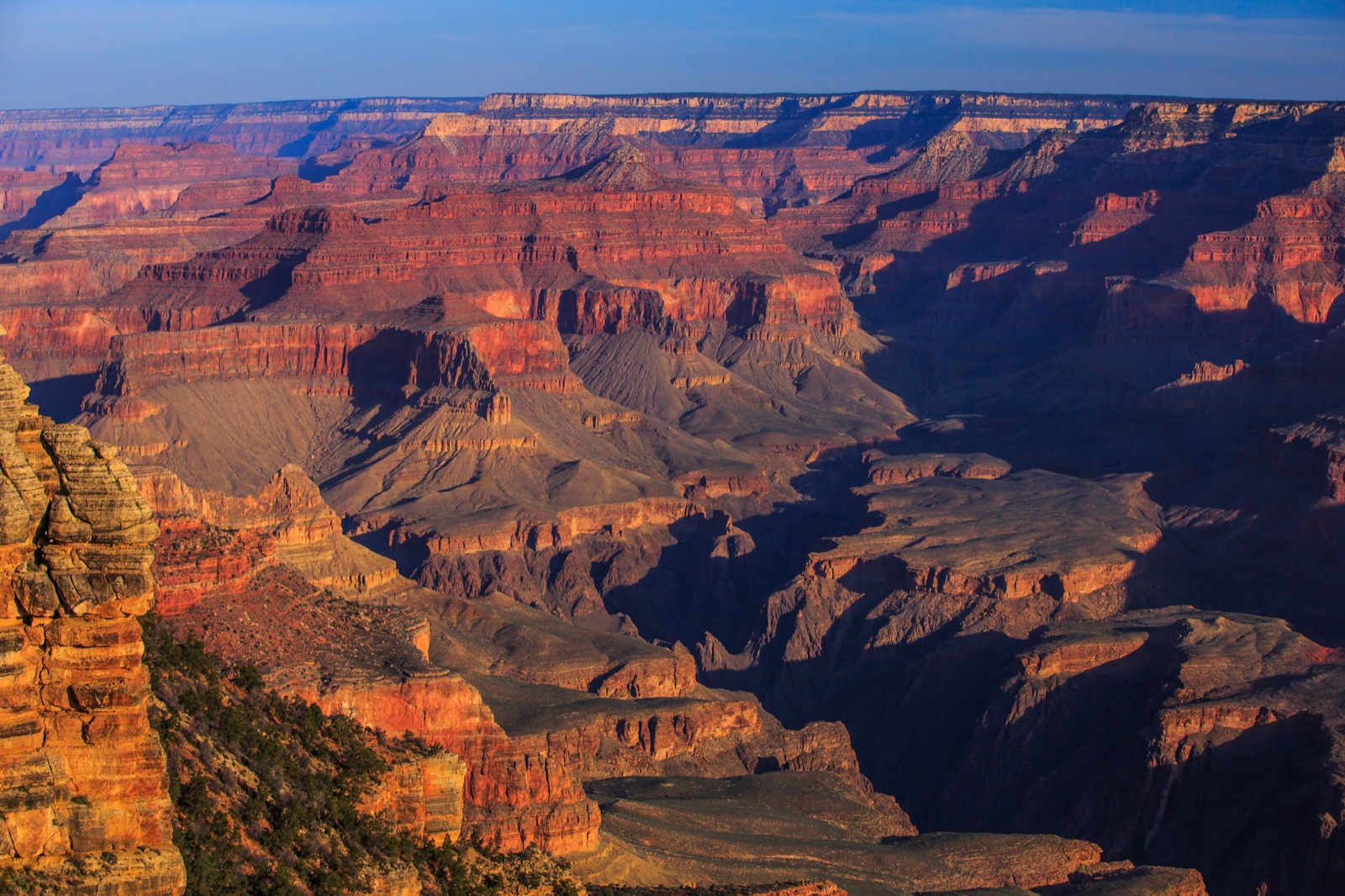
The Grand Canyon is the defining landform of the American Southwest, a mile-deep, 277-mile-long chasm carved by the Colorado River through layers of sedimentary rock that record nearly two billion years of geologic history. Established as a national park in 1919, today it draws around six million visitors a year, the great majority of whom enter through the South Rim, accessible directly from I-40 via Williams, Arizona. The North Rim sits 1,000 feet higher, sees a tenth of the traffic, and closes for the winter; reaching it from I-40 requires a 215-mile detour through Jacob Lake. The South Rim is open every day of the year, with paved overlooks at Mather Point, Yavapai Observation Station, and the historic Grand Canyon Village.
- 277 miles long, up to 18 miles wide, and 6,093 feet deep at its maximum
- Exposes nearly two billion years of geological history in clearly visible rock layers
- Roughly six million visitors per year, third most-visited national park
- Designated a UNESCO World Heritage Site in 1979
- Colorado River drops about 2,200 feet through the park