← All National Parks
National Park No. FL $100 nonresident fee

Everglades National Park

Everglades is the largest tropical wilderness in the United States and the only place on earth where alligators and crocodiles coexist in the wild. The park protects 1.5 million acres of the slow-moving freshwater "river of grass" that flows from Lake Okeechobee south to Florida …

I-75Nearest Interstate
1State
4FAQ
2Active Alerts
01 Park overview

Everglades is the largest tropical wilderness in the United States and the only place on earth where alligators and crocodiles coexist in the wild. The park protects 1.5 million acres of the slow-moving freshwater "river of grass" that flows from Lake Okeechobee south to Florida Bay, plus the mangrove estuaries of the Ten Thousand Islands and the marine waters of Florida Bay itself. Designated in 1947 to preserve a threatened ecosystem rather than spectacular geology, it remains one of the most ecologically significant — and most fragile — protected areas in the world. From I-75 the standard access is Exit 23 (Krome Avenue) into the main Homestead/Coe entrance, or Exit 80 (SR-29) for the Gulf Coast Visitor Center at Everglades City. The Tamiami Trail (US-41), which parallels I-75 across the peninsula, runs along the park's northern boundary and provides direct access to the Shark Valley Visitor Center.

  • Largest subtropical wilderness in the United States (1.5 million acres)
  • Only place on earth where wild American alligators and American crocodiles coexist
  • Designated a UNESCO World Heritage Site, an International Biosphere Reserve, and a Wetland of International Importance
  • Home to over 360 bird species, 40 mammal species, and the endangered Florida panther
  • Three separate visitor-center entrances; most of the park accessible only by boat or trail
02 Photos
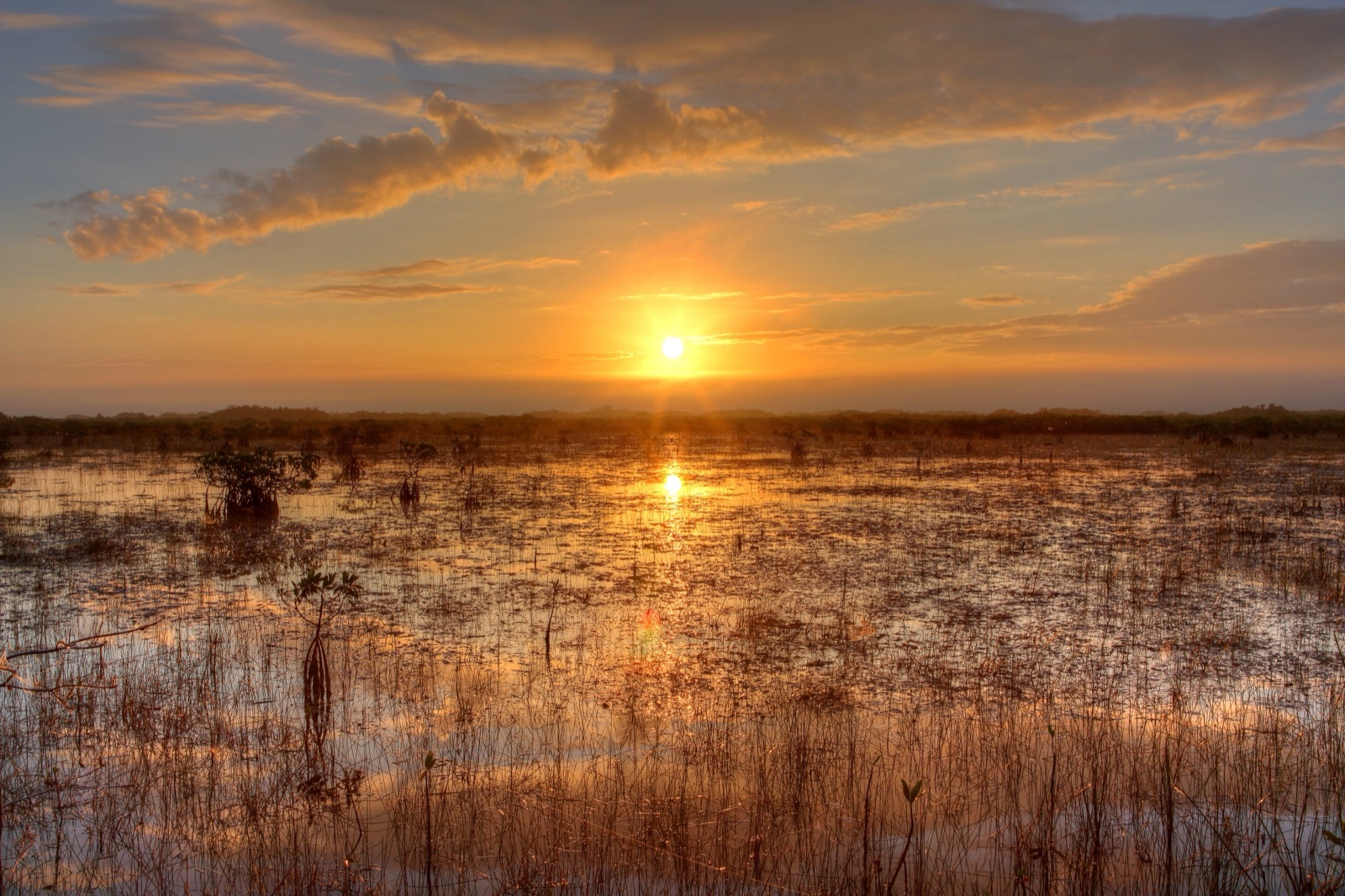
Sunset over the River of Grass, Everglades
Sunset over the River of Grass, Everglades NPS / G. Gardner via Wikimedia Commons · Public domain
03 Don't miss
  • Anhinga Trail boardwalk
  • Shark Valley 15-mile loop (tram or bike)
  • Flamingo Marina at the south tip
  • Ten Thousand Islands by boat
  • Ernest F. Coe Visitor Center
04 Getting there & truck/RV access
Route from interstate

From I-75

Exit 23 (Krome Avenue) — Miami end of Alligator Alley

24 mi south on Krome Avenue (SR-997) to Homestead, then west on SR-9336 to the Ernest F. Coe Visitor Center; or use Exit 80 (SR-29) for the Gulf Coast Visitor Center

Big rigs & RVs

Truck access

Krome Avenue (SR-997), SR-9336, and US-41 are paved and unrestricted for any vehicle size. Inside the park, the main park road from Coe Visitor Center to Flamingo is 38 miles of paved 2-lane road accommodating semis up to the Flamingo turnaround.

Parking: Generous lots at all three visitor centers. Truck stops are concentrated on I-75 — the closest from Exit 23 are at the Florida Turnpike interchange. Flamingo (south tip) has a marina lot but no commercial fuel.

Restrictions: No length restrictions on park roads. Several spur roads to boat ramps narrow significantly — Pa-hay-okee Overlook and Mahogany Hammock have small lots.

05 Seasonality & road closures

Best months: December through April — dry season, temperatures in the 70s, mosquito and biting-fly populations at their lowest.

Closures: Park is open year-round but the wet season (May–November) brings extreme insect pressure, near-daily afternoon thunderstorms, and occasional hurricane closures.

Notes: Hurricane season runs June–November; the park is regularly affected by tropical systems and may close with little notice. Verify status before traveling in late summer or early fall.

06 Entrance fees (2026)
PassPrice
Private vehicle (7-day) $35
Motorcycle (7-day) $30
Individual / walk-in (7-day, age 16+) $20
Park-specific annual pass $70 (Everglades Annual Pass)
America the Beautiful (annual, all NPS sites) $80 U.S. residents · $250 non-residents

2026 nonresident fee — applies at this park

Each non-U.S. resident aged 16 and older pays an additional $100 per person on top of the standard entrance fee. The fee is waived for visitors holding the $250 America the Beautiful Non-Resident Annual Pass (which also covers up to three additional adults). Children under 16 are exempt. U.S. residency is verified with a U.S. passport, U.S. driver's license / state ID, or Permanent Resident Card.

Fee-free days available for U.S. residents only beginning January 1, 2026.

Note: A separate $25 Everglades boat pass is required for personal-use boating in the park.

Official NPS fee page →

07 Current alerts (2)

Active National Weather Service alerts and FEMA disaster declarations affecting Everglades National Park's state(s). Updated every 15 minutes.

FEMA · Fire FL

COW CREEK FIRE

Levy (County)

FEMA · Fire FL

RAILROAD COMPLEX FIRE

Clay (County)

08 FAQ
How do I get to the Everglades from I-75?
For the main Homestead entrance, take I-75 Exit 23 onto Krome Avenue (SR-997) south, drive 24 miles to Homestead, then turn west on SR-9336 to the Coe Visitor Center. For the Gulf Coast district, take I-75 Exit 80 onto SR-29 south for 21 miles to Everglades City.
Does the $100 nonresident fee apply at the Everglades?
Yes. Everglades is on the list of 11 parks subject to the 2026 NPS nonresident surcharge. Each non-U.S. resident aged 16+ pays an additional $100 on top of the standard $35 vehicle entry fee, unless they hold the $250 non-resident annual pass.
What's the best time to visit?
December through April — the dry season — when temperatures are mild, mosquito populations are at their lowest, and wildlife concentrates around remaining water sources. The wet season (May–November) brings extreme insect pressure and hurricane risk.
Can I drive Alligator Alley to reach the park?
Alligator Alley is the local nickname for I-75 itself across the Everglades. To enter the park you exit at one of the three access points (Exit 23 for Homestead, Exit 80 for the Gulf Coast, or take US-41 / Tamiami Trail north of the park for the Shark Valley entrance).

Everglades National Park on the live map

See real-time weather alerts, wildfires, and road incidents around the park before you head out.

Open Live Map