← All National Parks
National Park No. CA · NV No nonresident surcharge

Death Valley National Park

Death Valley is the largest national park in the contiguous US — 3.4 million acres of basin-and-range desert anchored by Badwater Basin, the lowest point in North America at 282 ft below sea level. It also holds the world's hottest reliably recorded air temperature (134°F at Furn…

I-15Nearest Interstate
2States
4FAQ
1Active Alerts
01 Park overview

Death Valley is the largest national park in the contiguous US — 3.4 million acres of basin-and-range desert anchored by Badwater Basin, the lowest point in North America at 282 ft below sea level. It also holds the world's hottest reliably recorded air temperature (134°F at Furnace Creek, July 10, 1913) and one of the most extreme vertical reliefs in the country, with Telescope Peak rising 11,049 ft directly above Badwater. The park spans the California-Nevada line; from I-15 the standard access is Exit 246 in Baker, CA — "the gateway to Death Valley" — then 110 mi north on CA-127 and CA-190 through Shoshone to Furnace Creek. From Las Vegas, US-95 north to NV-373 / Death Valley Junction is a similar distance. Designated a national monument in 1933 and a national park in 1994.

  • Largest national park in the contiguous US (3.4 million acres)
  • Lowest point in North America: Badwater Basin, 282 ft below sea level
  • World record high temperature: 134°F (Furnace Creek, July 10, 1913)
  • Designated an International Dark Sky Park (Gold Tier, 2013)
  • Telescope Peak (11,049 ft) rises 11,330 ft above Badwater — among the steepest reliefs in the US
02 Photos
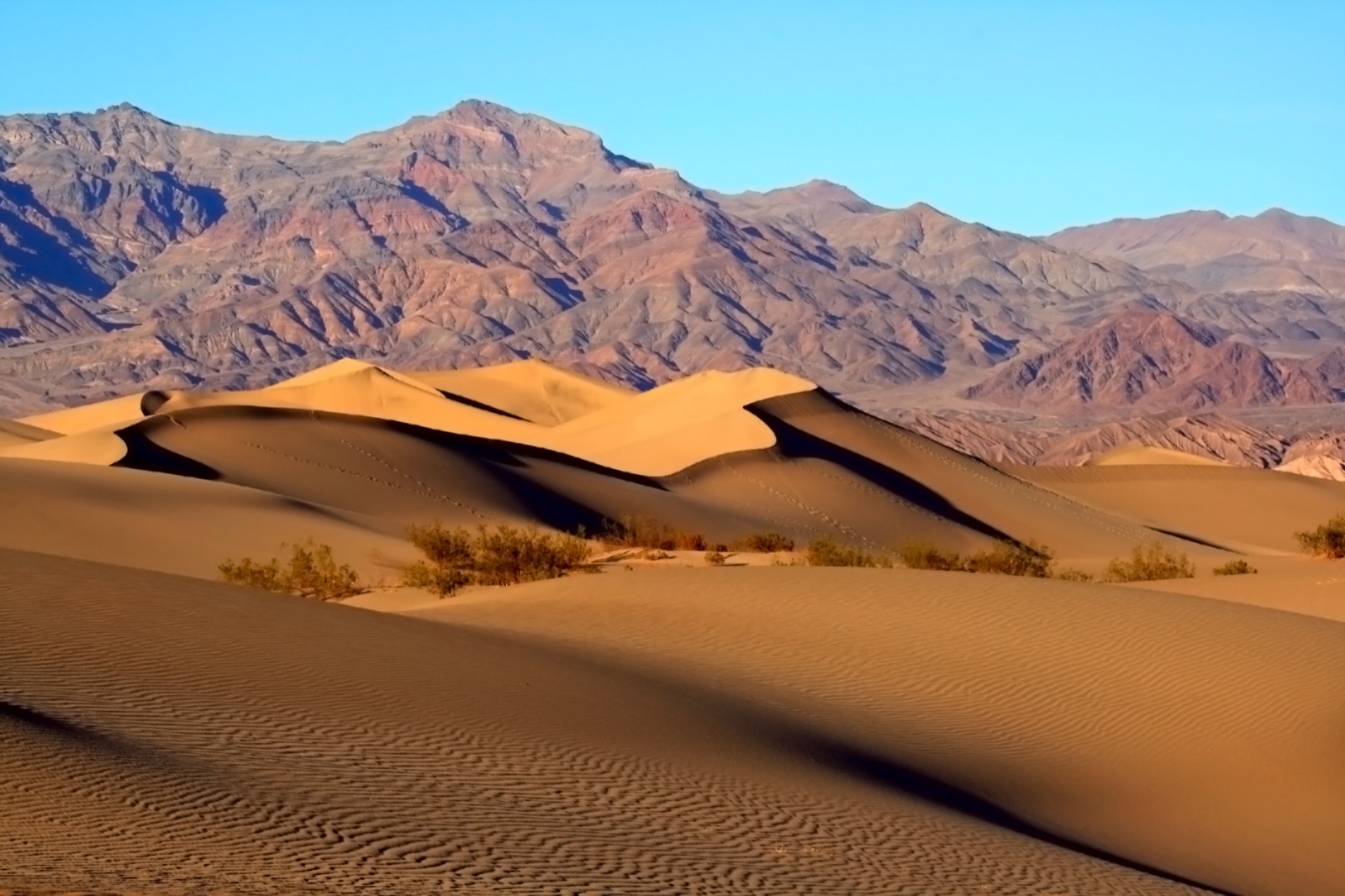
Mesquite Flat Sand Dunes at sunrise, Death Valley
Mesquite Flat Sand Dunes at sunrise, Death Valley Wikimedia Commons · CC BY-SA
03 Don't miss
  • Badwater Basin salt flats
  • Mesquite Flat Sand Dunes at sunrise
  • Zabriskie Point at sunset
  • Artists Drive scenic loop
  • Dante's View overlook (5,476 ft above Badwater)
04 Getting there & truck/RV access
Route from interstate

From I-15

Exit 246 (Baker, CA)

110 mi north on CA-127 and CA-190 to Furnace Creek

Big rigs & RVs

Truck access

CA-127 and CA-190 from I-15 are paved and unrestricted; large rigs reach Furnace Creek without difficulty. Inside the park, all paved roads accommodate full-size RVs and trailers, but secondary unpaved roads (Titus Canyon, Echo Canyon, Racetrack Valley Road) require high clearance and are off-limits to commercial vehicles.

Parking: Furnace Creek, Stovepipe Wells, and Panamint Springs all have large RV-capable lots. Truck stops at Baker (I-15) and Pahrump, NV are the closest commercial fuel outside the park; in-park gas at Furnace Creek and Stovepipe Wells is among the most expensive in the country.

Restrictions: Titus Canyon Road, Racetrack Valley Road, and Saline Valley Road are gravel and prohibited to RVs and trailers. Dante's View Road has a 25 ft length restriction near the summit switchback.

05 Seasonality & road closures

Best months: November through March — daytime highs in the 60s-70s, manageable temperatures even in the basin.

Closures: No seasonal road closures on the main paved network. After heavy rain (rare but consequential), unpaved roads and even paved CA-190 segments can be flood-damaged and closed for weeks.

Notes: Summer (June–September) routinely sees 115°F+ daytime highs; carry one gallon of water per person per day, never hike midday, and watch for vehicle overheating on long climbs.

06 Entrance fees (2026)
PassPrice
Private vehicle (7-day) $30
Motorcycle (7-day) $25
Individual / walk-in (7-day, age 16+) $15
Park-specific annual pass $55 (Death Valley Annual Pass)
America the Beautiful (annual, all NPS sites) $80 U.S. residents · $250 non-residents

2026 nonresident fee — does not apply here

The $100 NPS nonresident surcharge applies at 11 specifically named parks. Death Valley National Park is not on that list, so non-U.S. residents pay the same standard entrance fees as U.S. residents.

Fee-free days available for U.S. residents only beginning January 1, 2026.

Note: Cashless park — credit/debit only at entrance kiosks. No staffed entrance station; pay-by-app or self-service.

Official NPS fee page →

07 Current alerts (1)

Active National Weather Service alerts and FEMA disaster declarations affecting Death Valley National Park's state(s). Updated every 15 minutes.

TORNADO WATCH

Tornado Watch issued April 25 at 5:50PM CDT until April 26 at 1:00AM CDT by NWS Shreveport LA

Hempstead, AR; Howard, AR; Little River, AR; Nevada, AR; Sevier, AR

08 FAQ
How do I get to Death Valley from I-15?
Take I-15 Exit 246 in Baker, CA, then 110 miles north on CA-127 and CA-190 through Shoshone to Furnace Creek. The route is fully paved and unrestricted. From Las Vegas, NV, US-95 north to NV-373 is a similar distance.
When is it too hot to visit Death Valley?
June through September routinely sees daytime highs of 115–125°F at Furnace Creek. Most visitors avoid summer entirely; those who do visit limit activity to dawn and dusk. November–March is the practical visiting window.
Does the $100 nonresident fee apply at Death Valley?
No. Death Valley is not on the 2026 NPS nonresident-surcharge list. The standard $30 vehicle fee applies to all visitors.
Can I drive an RV on Titus Canyon Road or to the Racetrack?
No. Both are unpaved, narrow, and prohibited to RVs and trailers. Titus Canyon is also one-way. The Racetrack requires high-clearance 4WD and a spare tire — rentals from Furnace Creek are common.

Death Valley National Park on the live map

See real-time weather alerts, wildfires, and road incidents around the park before you head out.

Open Live Map