Is I-4 closed right now?
Our state DOT feeds show no closures on I-4 as of . This answer does not cover Florida (our feed has sent nothing in the last 3 hours). A closure the feeds have not reported will not show here.
Our state DOT feeds show no closures on I-4 as of . This answer does not cover Florida (our feed has sent nothing in the last 3 hours). A closure the feeds have not reported will not show here.
Our Florida feed has sent nothing in the last 3 hours, so this page cannot count what is on I-4 there.
Florida road conditions →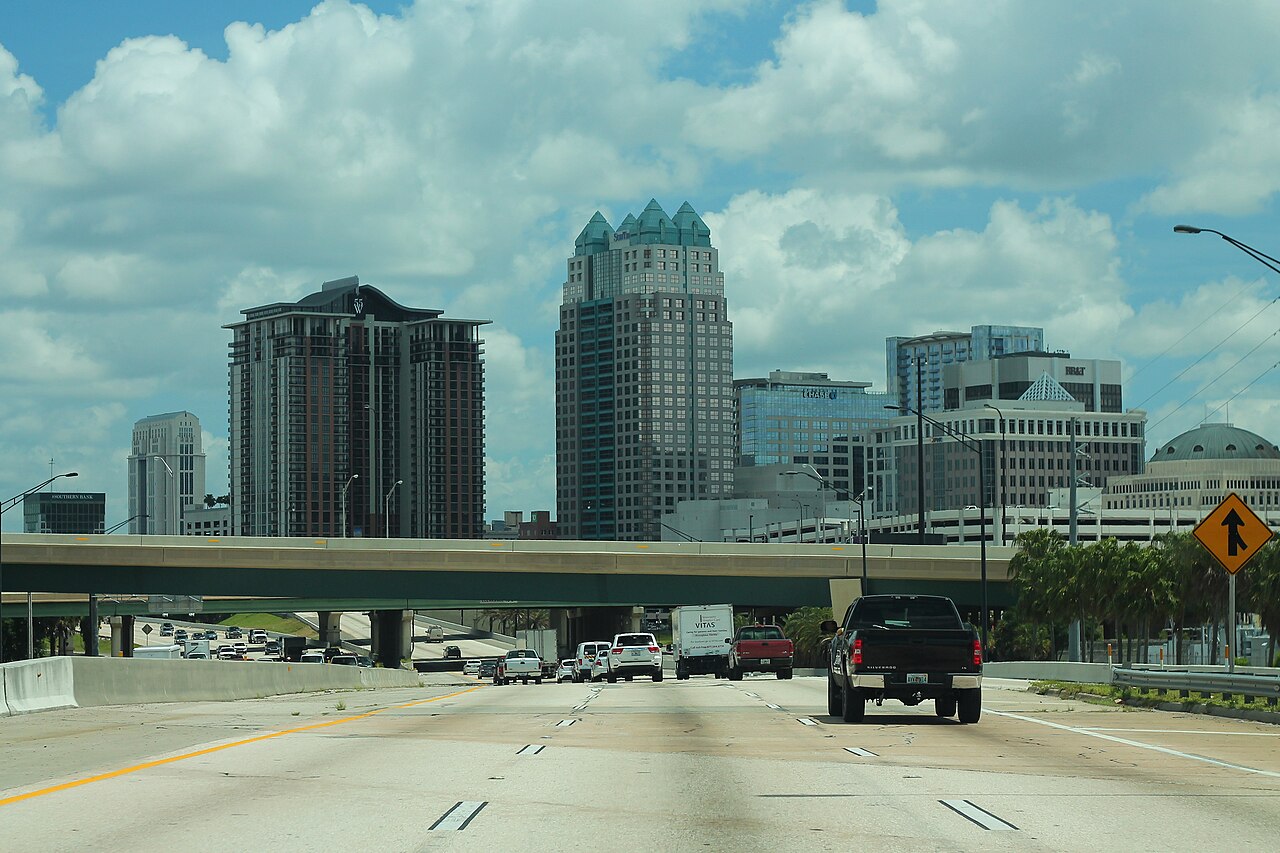
Interstate 4 runs 132 miles across central Florida from Tampa to Daytona Beach, tying together the major theme-park, tourism, and population centers of the Sunshine State. I-4 has one of the highest fatality rates per mile of any US interstate: in Teletrac Navman's analysis of NHTSA FARS crash data (2016-2019), the 132-mile stretch from Tampa to Daytona Beach was the only roadway in the report averaging more than one death per mile. It is also the only interstate in Florida that runs east-west.
I-4 is the main freight and tourism route across central Florida. The Orlando segment serves Walt Disney World, Universal Studios, the Orange County Convention Center, and the Orlando International Airport. This stretch draws heavy tourist traffic to the Orlando theme parks, which drives sharp seasonal peaks around holidays and school breaks. Truck volumes are heavy in the Tampa-to-Lakeland industrial belt, and the corridor is the principal connector between the Port of Tampa and the Atlantic ports via I-95 in Daytona. No parallel interstate provides a continuous through-route across the center of the peninsula, so I-4 carries this traffic alone (AARoads).
Geographically I-4 is entirely flat coastal-plain terrain. Weather hazards are dominated by sudden Florida thunderstorms, seasonal hurricane evacuations, and chronic congestion that persists day and night through the Orlando metro. The corridor runs through the most lightning-prone part of the country: Vaisala's National Lightning Detection Network found Four Corners, Florida, on the I-4 corridor southwest of Orlando, had the highest lightning density of any US location in 2022, and Vaisala ranks Florida the number one state for lightning density.
| State | Mile | City / Junction |
|---|---|---|
| FL | MM 0 | Tampa (I-275/I-75 jct) |
| FL | MM 14 | Plant City |
| FL | MM 28 | Lakeland |
| FL | MM 55 | Polk City |
| FL | MM 64 | Disney / Celebration |
| FL | MM 75 | Orlando (Universal area) |
| FL | MM 88 | Orlando (downtown / I-4 Ultimate Express Lanes) |
| FL | MM 101 | Sanford |
| FL | MM 118 | DeLand |
| FL | MM 132 | Daytona Beach (I-95 jct) |
Orlando metro (MM 64-101)
I-4 through Orlando is consistently among the most congested non-coastal interstates in the country. Holiday weekends and major theme-park events produce backups of 10+ miles. The I-4 Ultimate reconstruction added Express Lanes through downtown but the general-purpose lanes remain congested.
Florida summer thunderstorms (MM 0-132)
Central Florida's summer convective season produces sudden, intense thunderstorms with hail, damaging winds, and the highest lightning-strike density in North America. Pull off and wait. Florida storms typically pass in under an hour.
Hurricane evacuation routing
I-4 is the primary east-west evacuation route across central Florida. When hurricanes threaten either coast, FDOT routes evacuees inland on I-4 toward the opposite side of the peninsula. Trucks face long delays and may be ordered off the road.
I-4 / I-95 interchange, Daytona (MM 132)
Where I-4 ends at I-95 in Daytona is heavily congested, particularly during major NASCAR race weekends and spring break. FDOT publishes real-time alerts.
National Weather Service alerts in force in the states Interstate 4 runs through. Each one covers a county or a forecast zone, which may be far from the Interstate.
See every incident, alert, and road condition on Interstate 4 in real time.
Open Live Map